Author of the short story collections Something Special and The Woman in Red. Author of the Big Finish Short Trips Landbound and Battle Scars.
View all posts by Selim Ulug →
This article contains mild spoilers for 28 Years Later.
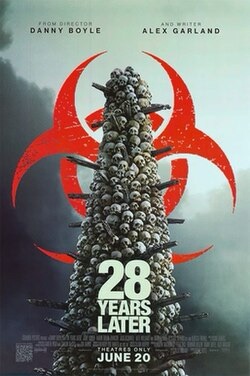
Sometimes, you need to check your expectations at the door before taking your seat in the theatre. I think that’s the case with the latest Danny Boyle and Alex Garland collaboration, 28 Years Later. This, the third in the franchise, is a different kind of zombie movie. Although there are definitely zombies, and there’s a lot of bloodletting, this is really a coming of age story. At the same time, you get to see what’s currently going on in rage virus-infected Britain.
Since 28 Weeks Later, the virus has mutated. We still have the zombies we saw in the previous movies, but there are now a couple of other types. One, which seems a poor adaptation, produces human walruses that slowly slither upon the ground, eating worms or whatever else they can happen to catch, including napping humans. The more dangerous types are called “alphas.” These are larger than the typical human, and tougher; they can withstand all sorts of punishment, though a bullet or arrow to the head is still fatal. They are also more intelligent, almost human-like in how they behave and how they are organized. We see, for example, a pregnant alpha. They don’t just eat uninfected humans, they feast upon animals such as deer.
Britain remains the only infected country, and its quarantine is enforced by warships visible from the coast. Although we saw the virus spread to France in the last film, we are told that the Europeans beat the virus back. Some take this as a repudiation of 28 Weeks Later, though it makes sense that, with the emergence of the rage virus in Britain, other countries would develop contingency plans just in case. I do wish we found out what became of the two children, but you can’t have everything.
The central character of 28 Years Later is twelve-year-old Spike. His community is nestled safely behind large gates on Holy Island in Northumberland, linked to the mainland by a causeway that is only traversable at low tide. His father has declared Spike ready for his passage to adulthood, which entails traveling to the mainland and killing his first zombies. They make it there and back again—just. Something Spike learns afterwards sends him back to the mainland in search of help for his mother.
There’s not a lot of story here, but there’s plenty of scares and a lot of growing up. The young Alfie Williams, who plays Spike, is a real find. Not only is he an amazing child-actor, he’s a remarkable actor, period, and he’s a stand-out in a cast that gives some very strong performances.
The film, unfortunately, doesn’t so much end as it stops. However, it does set up the sequel, to be released in 2026, called 28 Years Later: The Bone Temple.
I very much enjoyed 28 Years Later and I’ll be looking forward to the next one.
If, like me, you’ve read several books about how to write a novel, you’ll know that there are about as many writing processes as there are writers. In this post, I’ll try to tell you about mine. But take it with a grain of salt. After all, I’ve only written one novel. I may need to update this post after my second.
The first thing you should know about me is that, in my working career, I worked in a number of roles centered around software development. Back in the old days, project teams used a software development process called the waterfall method. First, you figured out what the software was supposed to do. This was documented as a set of requirements. Next you designed the software to do what it was supposed to, and your design would be developed in increasingly detailed layers until, at the most detailed layer, it was ready to be implemented in software. When the software was finished, it was tested. Seems reasonable.
The problem is that, in practice, the waterfall method didn’t work very well. It was all too often the case that the requirements needed to change along the way. When they did, any design and implementation affected by the change would need to be re-worked. Change was expensive and led to conflicts between the developer and the customer. Another problem was that, sometimes, when you got down to the nitty gritty of writing the software, you realized that, well, it wasn’t going to work. The design might have to be revisited. Maybe the requirements as well.
It was much better to take an iterative approach: identify some key requirements, come up with a software design “scaffolding,” and design and implement some of the key features. Each iteration focused on some number of features. You continue, refining requirements or adding new ones, doing some design, doing some implementation. Experience showed that it was much more effective to develop software this way. When requirements changed, and they almost always change, the cost was much less than if the waterfall process had been in play.
All well and good. So what does this have to do with novel writing? I’m sure you seen that some writers are “plotters” and some are “pantsers.” The former plot out the story in exacting detail. The latter write by the seat of their pants without a firm idea of where they are going.
My writing process was somewhere in the middle, and bears some resemblance to the iterative software development process. I started with the fact that this book was going to be a thriller. It had to be fast-paced, but not exhausting. In other words, action, break, action, break, as a kind of overarching structure. An architectural scaffolding, if you like.
I like to distinguish plot–what happens–versus what the story is actually about. The theme, in other words. I knew early on that I wanted one of the themes to be about family. Later on, I realized that mothers and daughters was going to be another theme. Another theme, the evolution of friendship, emerged later still. The point is, that even the themes were developed dynamically. In some cases, I knew what I was shooting for from the start, and other themes emerged through the writing. In those cases, I would retcon earlier chapters to support a new theme.
While I knew roughly where I wanted the story to end up, the road taking me there was quite dynamic. For instance, I was goofing around with my son, trading a pair of cool looking sunglasses. When I put them on, I looked in the mirror and said, “Maximum cool!” And then I dared myself to add a character to the book called Max Cool. After a bit of research, I found that Kool was a legit last name, so Max Cool became Max Kool, a construction foreman who instructs Katy on self defence techniques.
I kept a separate notes file, in which I jotted down questions to myself, possible directions in which to take the story, and even who the main villain would turn out to be, and whether a given character was good or evil. Also, there was a preliminary chapter breakdown, with just a sentence describing where I wanted a given chapter to take the story. This was fluid, but it was a kind of structure to get me started.
The story is set in 2021, and in the world of the story COVID never happened. Who wants to live through that again? One of the notes I made to myself was I was writing was to incorporate news stories from that time. The thought was that this would more firmly place the story in 2021. But virtually every headline that year was related to COVID, so you won’t see current events colouring the text.
At some point, maybe when the book was about half done, I wrote an outline of the last chapter. It helped reinforce in my mind what had to happen before I got there. It was quite a thing to finally reach that chapter and flesh it out. At around the same time I commissioned Georgia Cook—who I was aware of from her Big Finish Doctor Who stories—to provide a cover illustration. Having this in front of me proved quite inspiring. I didn’t post it online right away, but showed to family and friends, who all reacted the same way: it’s gorgeous!
The novel took me about three years to write. Not because I was writing great literature, but because I often wrote little more than a few sentences per day. Some days I didn’t write at all. I frequently read what had come before, so there was lots of chance to catch typos, plotting errors, and so on. It goes to show you, though, that you can finish a book even if you have little time to spend on it. I’m retired, so in theory there should be lots of time, but I never wanted writing to become a second career. It’s a hobby that I greatly enjoy. I found very quickly that if I forced myself to spend a given amount of time on it, that it wasn’t fun anymore. So, slow and steady it went until it was all done.
As I write, it’s all done except for the busy work. I hired an editor for my first short story collection, but realistically, a self-published book doesn’t make a lot of money. Having learned some important lessons from my editor the first time around, I’ve elected to edit my own writing. For better or for worse. And that’s what the last few weeks of the writing process has been: iterations of reviewing, revising, and repeating until I don’t find anything more I want to change. The last stage will be to work through Amazon’s KDP process to get the book up at their store.
If you’re working on a novel, I hope this helps in some small way and I wish you all the luck and success in the world.
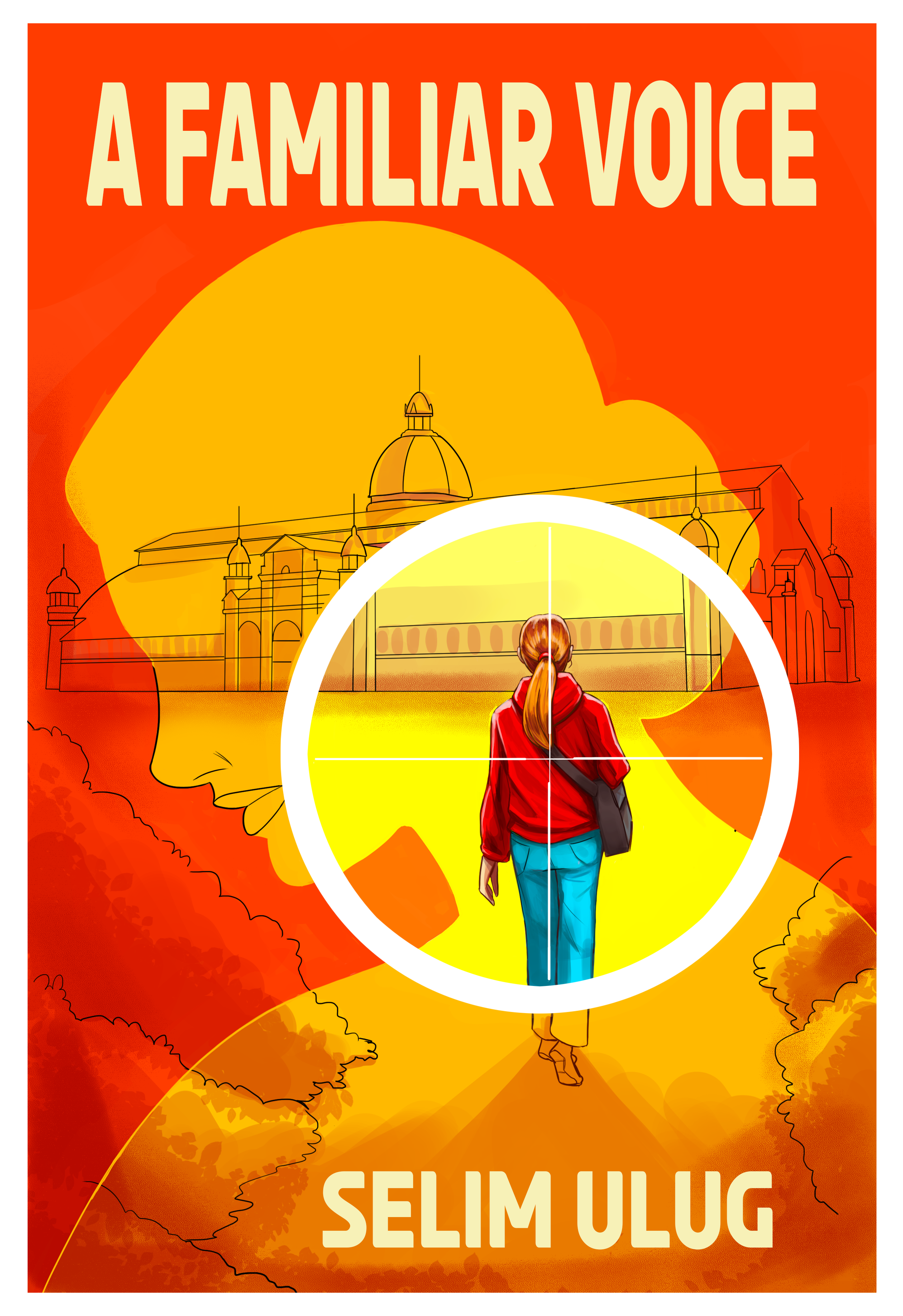
I’ve mentioned in other posts that I’m working on a novel called A Familiar Voice. I can finally announce that it will be available in November. Here’s the beautiful cover art by the omni-talented Georgia Cook.
A Familiar Voice is a sequel to the novelette “A Voice” which appeared in my short story collection, Something Special. The book includes a slightly revised version of that story as well as the novel.
What’s it about, you ask?
When the men responsible for trying to frame—and kill—Katy LaPointe were arrested, she breathed a sigh of relief and thought that her troubles were over. For a time, they were. But a failed drive-by shooting makes Katy realize that her troubles are just beginning. Meanwhile, Laura Seeback, a high school teacher, needs help, even if she doesn’t know it. A familiar voice tells Katy that she can help herself by helping Laura. As the attempts on their lives become more desperate, can Katy and Laura stay alive—and out of jail—long enough to find out who wants them dead?
In other words, A Familiar Voice is a thriller. This is my first novel, after having written many short stories. In a future post, I’ll talk about the experience and process of novel writing.
Star Trek: Strange New Worlds: Asylum, by Una McCormack, is the third Star Trek audio book I’ve listened to this year. It is very much a character-based story, and features Una Chin-Riley in two time periods: on the “present day” Enterprise with Christopher Pike in command, and 25 years earlier, when Chin-Riley was a senior cadet at Starfleet Academy.
As an aside, I’m glad they gave Number One a name—really, they had to, didn’t they?—and I think they picked a perfect name, but after decades of knowing her as Number One, referring to her as Una is, well, a process.
Back at Starfleet Academy, Ensign Christopher Pike, who is on leave pending an investigation of an incident in which he was involved, is giving some lectures on what life is really like “out there.” Pelia, who is one of Chin-Riley’s instructors, encourages her to sit in on Pike’s lectures. She does so, and after a rocky start, they become fast friends.
Meanwhile, Chin-Riley’s roommate is involved with Federation asylum seekers, specifically, a family of Euxhana, a cultural and ethnic minority on Chionia. When Chin-Riley learns about them, she becomes interested and gets involved as well. In the present day, the Enterprise is hosting trade negotiations between the Federation and the Chionian government. And here is where the underlying theme of this book comes in. For the treatment of the Euxhana reflects the treatment of Indigenous peoples in North America, with the Chionians removing the Euxhana from their traditional territories, and attempting to erase their culture and language. The difference is that the treatment of our Indigenous peoples was much worse.
It is worth pointing out that, since the beginning, Star Trek has been a vehicle for exploring social issues of the day. At the time, they got away with it because it was set in space in the future, not Earth in the 20th Century. So, there were episodes dealing with racism, mutual assured destruction, the impact of artificial intelligence, and others. In fact, every time Uhuru appeared onscreen in the 1960’s, a Black woman on the bridge of a starship, that was social commentary. It’s also worth pointing out that “Asylum” isn’t the first Star Trek story to deal with the treatment of Indigenous peoples. This was also explored in the Next Generation episode, “Journey’s End.” To sum up, if you prefer your Star Trek to be free of social commentary, this isn’t the story for you. But if, like me, you feel that social commentary is at the heart of Star Trek, you’ll be well rewarded.
In the present day, Chin-Riley tries very hard to put right a bad choice she made in the academy with regard to the Euxhana refugees. This is the tension at the heart of the story and contributes to the immense readability of this well-written book.
Meanwhile, the audio version of Asylum is ably narrated by Robert Petkoff. Among his many voices, he captures the cool-under-fire persona of Christopher Pike particularly well. Also, believe it or not, he does an amazing Pelia. Overall, his narration is excellent and highly recommended, as is the book as a whole.
A woman walks into a bar and inquires of the Fenris Ranger therein how she herself might join the rangers.
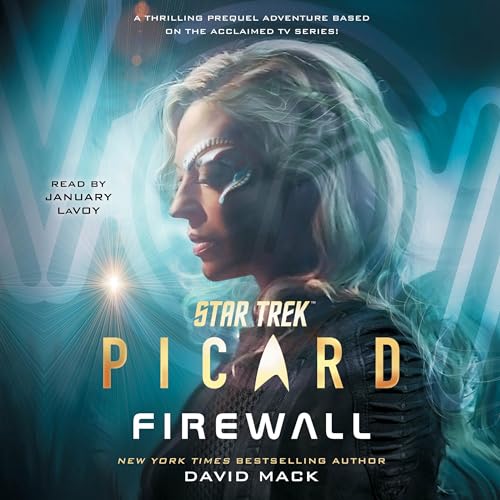
This is how David Mack’s Star Trek Picard: Firewall opens. The novel bears some comparison to Una McCormack’s Star Trek Picard: Second Self, which I wrote about previously. Like Second Self, the audio version of Firewall is narrated by January LaVoy, the extraordinary narrator of a thousand voices. Her Kathryn Janeway is so authentic you’d be forgiven for thinking they’d brought in Kate Mulgrew to speak the part. Not only can she pull off many voices, but LaVoy is an amazing actor who delivers a full gamut of emotions.
Star Trek Picard: Firewall
As I’ve mentioned before, I’m not generally a fan of spin-off novels. But, like Second Self, Firewall very pleasantly surprised me. It’s reads like it’s written for adults with some very mature themes, including genocide and food as a weapon. Both remain depressingly apropos to the times in which we live.
Whereas Second Self is concerned with Raffi (Raffaela Musiker), Firewall explores the history of the other side of the coin, Seven of Nine, and takes us from Voyager’s return up to the events of Star Trek Picard. Seven of Nine’s growth is a joy to behold. Early on, we see her at her lowest: rejected from Star Fleet Academy because of her history with the Borg; lost; working at menial jobs; seeking human contact in whatever form she can. Things change when she becomes involved with a Fenris Ranger operation. She begins to grow personally, as a tactician, and as a leader. She comes to believe in her own competency.
I appreciate the fact that, for the vast majority of the book, there are few prerequisites. It is helpful to know something about Seven of Nine from her time on Voyager, and her relationship with Captain Janeway. Still, there’s a reveal in the book and I could tell it was meant to be a big deal. Sadly, it went right over my head. My reaction was, Huh? I’m a fan, you see, but not a “super” fan. Not of Star Trek or any other fandom, to be honest. Thankfully, we have the Memory Alpha wiki and that set that to rights.
The bottom line is that I highly recommend Star Trek Picard: Firewall. The prose is a pleasure to read, and the story is very exciting and very touching. And it’s Star Trek. What more could you ask for?
As of June, 2025 I’ve turned seventy. This means, depending on whether you’re a glass half full or a glass half empty kind of person, that I’m either entering the prime of life or am just plain old. If I am getting old, I don’t really mind. After all, there is only one alternative, and it’s not very attractive. But it’s a hard thing to get your head around. My generation, the dreaded Boomers, defined themselves by their collective youth. I was still quite young in the 1960’s, but aware of the sense of optimism that, once our generation came to power, everything would be better. Sadly, that hasn’t quite happened. In fact, you could make a reasonable case that we’ve collectively screwed things up worse than just about any other generation. Does it help if I say we meant well?
Selim Ulug, June, 2025
It’s an interesting age, seventy. You can do most of the things you’ve always been able to, though you might find you’ve less energy than you did earlier. At the same time, you can clearly see eighty looming on the horizon. Assuming that I continue to avoid cancer and heart disease, I can be reasonably confident of hitting eighty. After that, based on what I’ve seen around me, all bets are off. I might make it to ninety. Most men don’t. And, in their eighties, pesky medical problems seem to have a way of piling up and quality of life can take a big dip. The long and short of it is that this is the last decade where I can reasonably count on being healthy enough to do what I want.
The problem therein is two-fold. First, what is it that I really want to do? Because that seems to change as time goes by. More on that in a minute. The second problem is that, at this point, a decade flashes past in the blink of an eye. It seems ridiculous to think that ten years has passed since my sixtieth. The next ten years will be likely pass even more quickly.
1955 Hits, Source: Apple Music
So, what do I want to do? That is the question of the hour. Or rather, the question of the decade. As an example of the problem, let’s consider books. I long imagined that, when I retired, I’d spend time re-reading old favourites. Along the way I’ve accumulated many books. So many that, at the time of writing, they’re in piles on my basement floor in addition to filling up multiple book cases. A number of my paperbacks date back to the 1960’s. Back then, I was terrified of breaking the book’s spine, and read them at odd angles while opening the book a crack. Perhaps not surprisingly, those books are in great shape. They include many of the Doc Savage series, a lot of Edgar Rice Burroughs, H.P. Lovecraft, Michael Moorcock, and Robert E. Howard. There was Arthur C. Clarke, Isaac Asimov and, a favourite when I was young, E.E. “Doc” Smith. I was also a bit of a science nerd, so I have a couple of books about cosmology that are so old that they were written before the Big Bang was universally accepted, and they also cover a competing theory called Continuous Creation. I don’t spend a lot of time re-reading these books. To be honest, many haven’t aged particularly well, or perhaps were never meant for adult eyes. But they were a bright light in my childhood and I plan to keep them around a while yet. I do re-read my beloved Charles Dickens novels, but not a lot else. I don’t tend to re-read most of the books I’ve acquired since, preferring to read new books over old. So, I’m reluctantly coming to the conclusion that I don’t need to keep most of my books. That being said, you’ll have to pry my favourite, The Little Prince, from my cold, dead hands.
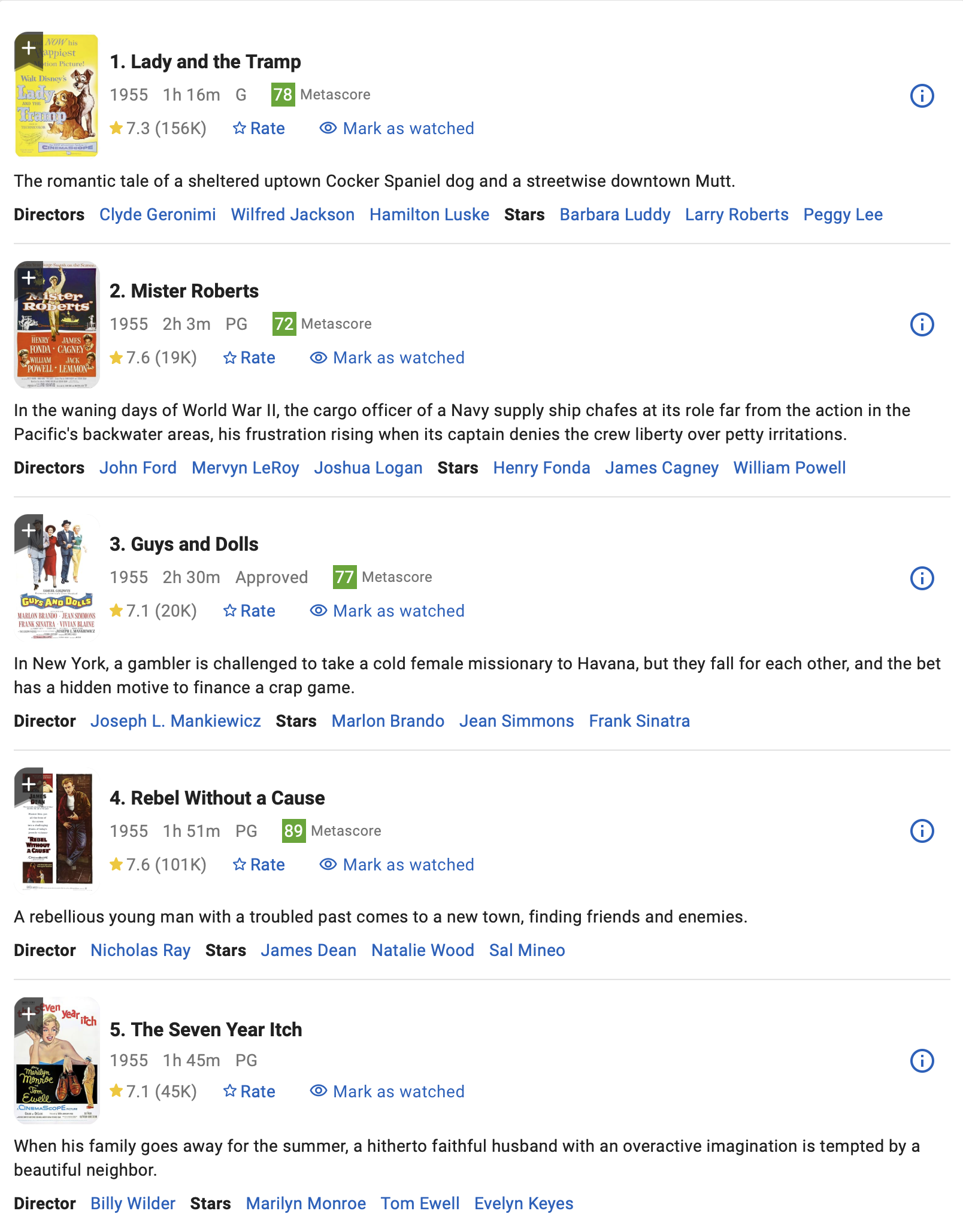
Highest Grossing Movies of 1955, Source: IMDB
The world has changed a lot in seventy years. Among Doctor Who fans, it’s popular to ask, who was on the cover of Doctor Who Magazine the month they were born? In my case, not only was there no DWM, there was no Doctor Who! For me, 1963 was the year of Fireball XL5. I lived, breathed, and slept that show. People were sick of me going on about it, and I remain fond of it to this day. I also remember, in 1963, watching the funeral of President Kennedy on our black & white, vacuum tube TV. I remember pressing my nose against store windows when colour TVs started to become available. When we got ours, I particularly loved Batman, Star Trek, and whatever the Bugs Bunny / Road Runner show was called back then. My family was in England when Neil Armstrong stepped foot on the moon. It was the middle of the night, so, sadly, we didn’t watch it live. I was at a conference in the early 1990’s when a speaker asked the audience if we’d heard of a program called Mosaic. None of us had. This was our first introduction to the World Wide Web. Computer networks had been around for ages, but not a network of networks. Not the Internet. This, of course, changed everything.
As an aside, have you seen the movie Last Night in Soho? It concerns a modern-day fashion designer who finds herself transported to the Soho of the 1960’s. As I was watching, I found myself thinking, wouldn’t that be a thing—walking the streets of Soho in the 1960’s. Then I had to laugh out loud. Because I’ve done it. My mother’s family lived in the north-east of England. When we went to visit, we’d stay a night or two in London to get over the jet lag before traveling up north. We stayed at the Bonnington Hotel (now a Double Tree Hilton) and walked through Soho to a Turkish restaurant that was a favourite of my father’s. My recollection of Soho is a bit different to what I saw in the movie. It seemed rather seedy to my young eyes, but, most notably, we passed several establishments whose exteriors were decorated with black & white photos of topless women. And while my young eyes gaped, my father growled that I should watch where I was going. For what it’s worth, the restaurant was pretty good. I don’t remember its name, but no doubt it’s long gone. As for the hotel, the rooms were tiny and on each floor there was a TV room. There were no TVs in the actual guest rooms. I recall the TV room on our floor packed to overflowing with people. I walked into the lobby of the hotel in 2019 when I was last in the UK. Clearly, they had done the place up a bit. I didn’t like it.
With age comes a sort of wisdom. For instance, I can impart to you the Secret of Happiness at no extra charge. It boils down to the same 80-20 rule that applies to so many things. No matter where you are in your life, the business of life is drudgery. Groceries. Cooking. Cleaning. Working! All the busy work that needs doing. That can account for 80% of your time, and that might lead you to think you’re doing something wrong. You’re not. What you need to focus on is, not the drudgery, but that golden 20% — time spent with friends and family, quality alone time, whatever makes you happy. Simply put, the secret of happiness is to not expect happiness every moment of every day, but to appreciate that 20% of the time when you’re in your happy place. And anyway, if not for the 80%, the 20% wouldn’t seem nearly so lustrous.
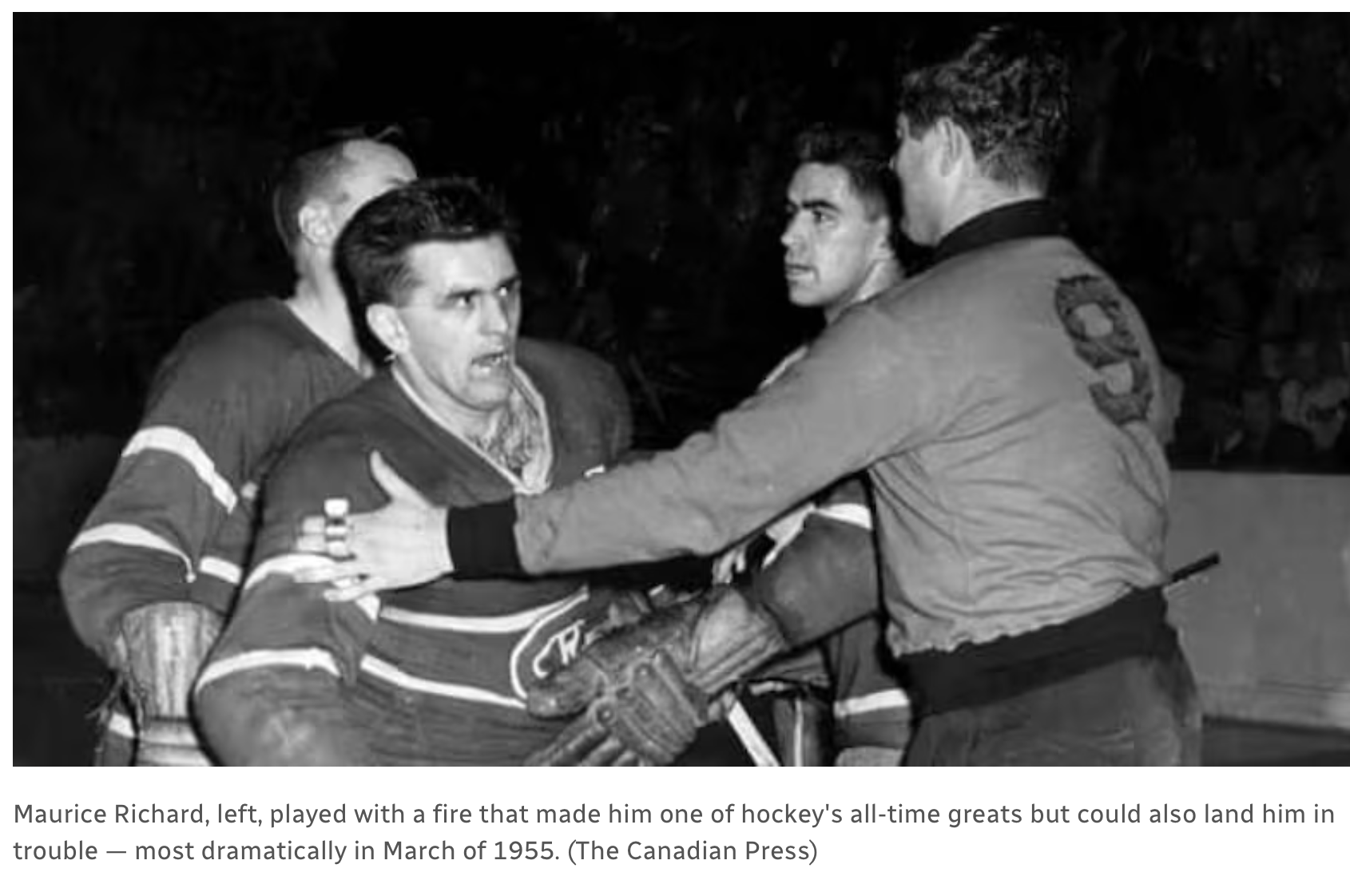
Montreal Riots after “Rocket” Richard Suspended in 1955
Put another way, the old adage is true: happiness comes from within rather than without. It’s being thankful for what you have, rather than longing for what you haven’t.
Happiness can also be had by thinking back to key moments that you collect throughout a lifetime. When I started university, I wanted to be a scientist. It took a while, but getting accepted to grad school was definitely a key moment. Another was when my first scientific paper was published. Still another, of course, was when my Doctor Who stories “Landbound” and “Battle Scars” were published by Big Finish. That was a beautiful, mad time and I treasure the memory of it. And still another key moment was when I self-published my first collection of short stories. I suppose another will be when I self-publish my first novel. Assuming I ever finish the thing. Kidding! A Familiar Voice will be available later this year. (If you’re wondering, there have also been many key personal moments, but they’re, you know, personal.)
Does all of this mean that we have to be satisfied with our lot? With what we have today? Of course not. So here’s the actual, true secret of happiness: It’s learning to know what it is that makes you happy, and being happy with what you have while striving for the things that make you happy that you don’t have. I think it’s the striving that gives us purpose, and having a purpose is something that makes most of us happy.
Thanks for reading. May you enjoy many years of happiness.
Doctor Who: The Alternative War is a two-part fan audio series from TT Productions 23. The “alternative” universe branches off from the TV Doctor Who universe at the moment of the Eighth Doctor’s regeneration. In the alternative universe, the Doctor regenerates into a female incarnation who is still very much the Doctor, but who must find a way to bring the Time War to an end. She is the ninth Doctor of this universe.
The first part, simply called “Doctor Who: The Alternative War”, was my first stab at a full-cast script. I won’t deny that I was in a bit over my head. Partly because I took on too much. I brought the cast together but didn’t have the means for them to record it live, so each actor performed in isolation, with the exception of Alia and Abi, who recorded together. I stitched the recordings together as best I could. Fortunately, Jaspreet Singh came to my rescue and tweaked the dialog and added sound effects and music. I enjoyed the result, but came away thinking that I could have done better. I could have written a better script.
And I did do better with the sequel, “Doctor Who: The Alternative War—Reprieve.” The recording used the normal TT Productions 23 process and was much better for it. There was a table-read to iron out the kinks, and then the recording proper with all the actors present. And boy, did the actors nail it. Abi brought us a more seasoned Aliana. Jack played two roles, the 10th and 11th Doctors. He nailed each of them and switched between them like a slippery chameleon. You’d have sworn there were two different actors present. I’ve always been fond of Jaz’s performances as the Third Doctor, and he tackled the role once again with gusto and vim. Marcus gave us a War Master who delighted in getting under the Doctor’s skin. But it was the Master’s sparring with Aliana that was a highlight for me. And then there’s Chelsea and Sam who played the constantly bickering Time Lords Strange and Love. I could listen to those two go at it all day. You would never think that the two actors had never met before the recording. The striking cover art is, as usual by @johannesviii.bsky.social.
As for the script, I was very happy with the result. It was a bit of a large cast for the length of the story, with three Doctors, a companion, the Master, and Strange and Love. I wanted each character to have a purpose—to have agency. And so, the third Doctor has his own little adventure and gets to drive a fast car and reverse the polarity. Aliana, having grown since the first adventure, is often the adult in the room. The eleventh Doctor has a bad day, getting eaten by a lake serpent and then having his sonic screwdriver melted. The tenth Doctor, still recovering from his regeneration, has to keep his ragtag team focussed on the job at hand. And if you’re fond of ’50’s era sci-fi movies, there’s something here for you, too.
When I think of 2019, I think of it as The Before Times. Before the world was frozen in time while researchers scrambled for a vaccine to beat back the beast known as COVID. Some pretty good things happened that year, including my first visit to a Doctor Who convention. I had the pleasure of attending Chicago TARDIS and enjoyed an all-too-brief encounter with Katy Manning.
Katy, of course, was Jo Grant, assistant to the third Doctor, played with panache by Jon Pertwee. Katy left the show after her character married environmentalist Clifford Jones. She has since played Jo Grant and Jo Jones many times for Big Finish.
She was a delight on the show and an even bigger delight in person, doling out hugs to all the fans who lined up for autographs. As we chatted, I might have let slip that I’d written a couple of stories for Big Finish. After all, “Battle Scars”, my second Short Trip for Big Finish, was released just a few months earlier. She narrated Short Trips sometimes, she said, and suggested I write one for her.
A story idea came to me almost immediately. I let it percolate until late last year when I decided to go ahead and write it as fan fiction. As I do these days when I get the urge to write Doctor Who. If there was any chance that Katy would narrate the story, I would have centred it around Jo Jones and Kate Stewart. However, since the story was going to be fan fiction, I decided that it would feature Jo Grant and the Brigadier, and as the story progressed they would bond with each other and gain a measure of mutual respect. The result is a short story called “Panic in the Cave.” It’s hosted by the Doctor Who Project.
Something is stirring in the cave system beneath Yorkshire. Locals are near deafened by eruptions of bone-rattling sound, and tremors have been reported, sufficient to split the earth and swallow vehicles. Before he can be notified, the Doctor takes his TARDIS for its first test flight since the Omega affair. Jo Grant, eager to prove her worth to the Brigadier, insists upon her involvement in the investigation. But, without the Doctor’s support, will she be able to face her fears and confront the unknown?
The Doctor Who Project hosts edited fan fiction stories which are set in alternative timeline. They also host “Brief Encounters” which are short stories set in the “classic” Doctor Who timeline. The editors had some good suggestions for improving my story. Do check the site out.
And please have a look at “Panic in the Cave” and let me know what you think of it.
I knew a guy who, before purchasing a book, read the last couple of pages. Why would you do that? I asked him. Wouldn’t that spoil the whole thing? Because, he said, why would I read a book if I don’t like the ending?
Fast forward to the present, where I’ve been listening to January LaVoy’s narration of Una McCormack’s Star Trek Picard: Second Self. I started at the beginning, but even before reaching the end, I knew that I could recommend this book without hesitation. Doubly true now that I’ve listened to the whole thing.
To be honest, I don’t often enjoy spin-off novels. There are exceptions, most notably Timothy Zahn’s Thrawn trilogy. And there are others I’ve enjoyed, including some Star Trek and Doctor Who novels, but Second Self is something special. Why is that?
Well, for one thing, it’s clearly a book for adults, or at least for the older YA crowd, with its mature themes of war-time atrocities and drug addiction. This book has other things going for it. Motivations are clear. There is a lot of inner dialog which expands our appreciation of Raffi’s (Raffaela Musikerz) character. Backstory, of which Star Trek has untold volumes, is provided as required without overwhelming the current story.
Second Self concerns Raffi, who, at the behest of Admiral Jean-Luc Picard, undertakes an off-books mission to bring a war criminal to justice. The problem is, intelligence reports have the criminal last seen on Ordeve, a planet with which Raffi has unhappy associations. The focus of the book later shifts to Raffi’s earlier time on Ordeve, and then to events that occurred before that. It’s a good story-telling technique, motivating us to understand what went before.
Aside from the very effective prose, there’s January LaVoy’s exquisite narration, with so many voices that you’d almost swear that this was a full-cast audio. I’ll be looking for more audio books narrated by this voice actor.
To be honest, I picked up this audio book because it was on sale. Now that I’ve listened to it, I would happily pay full price. Pick up a copy or listen to the audio version. If you enjoy Star Trek, you’ll be glad you read Second Self.
This post contains SPOILERS for Star Wars: The Acolyte
If you’ve listened to “Landbound“, the Doctor Who Short Trip I wrote for Big Finish, you’ll know that it begins with the Third Doctor driving off in a temper from Unit HQ until he finds himself at the seaside in Whitby. In my first draft, the Doctor was simply having a bad day and was fed up with the Brigadier and his rules and regulations. Ian Atkins, my editor, suggested making the reason for the Doctor’s anger clearer by setting the opening right after the TV episode, “The Silurians.”
The Silurians, an intelligent, lizard-like race, ruled the world before humans came along. They’ve since been in hibernation. In the episode, they awake and wish to resume their place on the Earth’s surface. The Doctor tries to achieve a peaceful solution only to have his efforts undermined by the Brigadier, who seals them underground and likely kills them all in the process. The Doctor, of course, is furious.
With that change, the reason for the Doctor’s anger in “Landbound” begins becomes much clearer. And clear motivation, I’ve learned, is key to good storytelling.
Which brings us to Star Wars: The Acolyte, the latest Star Wars series from Disney, in which very few character motivations are clear. For instance, the Jedi are shocked — shocked! — that the Witches of Brendok are raising two children. I wonder where they thought big witches came from if not little witches. Are the witches inherently evil? Or just different. Or does different equate to evil? Do witches roam the galaxy, turning people into newts? Why is it so very important to the Jedi to remove these children from the witches? Particularly since these not-so-old children are apparently too old to train.
What motivates Torbin, the Jedi who instigated the awful events on Brendok? Why is he so whiny? Why does he want so badly to return to Coruscant? Why does he wear his heart on his sleeve when the mission of the Jedi seems to be to drum emotion out of their students (more on that in my next post)? Why does he wantonly disregard his master? Is he campaigning for Worst Padawan Ever?
There’s a tracker in the show, a diminutive creature with a great sense of smell. He’s not just a dog on two legs, though. He’s quite handy with technology as it turns out, and effectively caused Sol’s ship to crash-land. What’s his story? How does he communicate with people? Why does he do what he does?
In the final episode, Osha and “the Stranger” leave but apparently they simply must leave Mae behind. Why is that? Is the ship not big enough for three? Is it that a Sith can only have one apprentice at a time? Enquiring minds want to know, and it wouldn’t have taken long to explain.
There are other questions, of course, but I won’t list them all. Except to question Jedi Master Vernestra Rwoh, and her desire to hide what’s going on in Acolyte from the Jedi Council.
There are a lot of screen writers out there and by all accounts it’s nearly impossible to get a treatment to the point of actual production. Studios, it seems, have the luxury of selecting from the best of the best. Given that, I’ll end with a final question: why would Disney accept a script in which reasonably clear motivation is so lacking?