I don’t know about you, but as time goes by it’s increasingly seldom that I find books that are genuinely hard to put down. In fact, it seems more and more common for me to discard a book if it hasn’t grabbed me by at least page one hundred. So imagine my glee when I find myself reading two books that are unputdownable. Don’t judge me. The fact is, I usually “read” two books at a time. The reason read is in quotes is that one of the books will be either a physical book or an eBook, and the other an audio book. When I sit down to read, I’ll generally pick up the print book. When I’m walking, cleaning, or whatever, I’ll often listen to the audio book. The psychologist in me finds it fascinating that I never get confused about what happened or who appears in which book. Perhaps it’s the fact that the input modalities are different. But I digress.
The first of the two books that I’m particularly enjoying at the moment is Labyrinth of the Spirits by Carlos Ruiz Zafron, the fourth and final book in the Cemetery of Forgotten Books series. It has been a long, long time since I’ve encountered an author whose prose has this level of beauty, whose characters are so well developed, and whose stories so relentlessly draw you in. The books are part literary novel and part mystery with, possibly, a touch of fantasy. It depends on how you interpret them. For me, the first and fourth books are the strongest, both equally compelling. I’ve recently finished my third reading of the first, The Shadow of the Wind, and I’m on my second reading of the fourth. This time around, I’ve read the books in order. The second and third books, The Angels Game and The Prisoner of Heaven, are weaker in my opinion, especially Prisoner, though that book, at the very least, sets things up for the fourth. Angels is very good, but confusing, as I wasn’t sure at times whether the story was unfolding as written or whether the protagonist was simply caught up in a story of his own creation.
The second book I’m loving right now is The Evolutionary Void, the third in the Void trilogy by Peter F. Hamilton. Here’s the thing: when you read a trilogy by Hamilton, you need to realize that the story is going to be big. Really big. And there are many, many characters and locales, and many subplots that will, miraculously it seems, come together at the end. The Void books represent the second trilogy of Hamilton’s that I’ve read. In both cases, I wondered as I read the first book whether the author wasn’t just pot boiling for the sake of producing a thick book. In both cases, I was dead wrong. The first book, as it should, introduces characters and situations and conflicts and get things going. Things start looking pretty bleak in the second book, and in the third, well, I’m not finished Evolutionary yet but I have hopes for a satisfying conclusion.
I hope that’s enough to entice you to check out these books. I’d make this a longer post, but I really need to get back to my reading …
If, like me, you’ve read several books about how to write a novel, you’ll know that there are about as many writing processes as there are writers. In this post, I’ll try to tell you about mine. But take it with a grain of salt. After all, I’ve only written one novel. I may need to update this post after my second.
The first thing you should know about me is that, in my working career, I worked in a number of roles centered around software development. Back in the old days, project teams used a software development process called the waterfall method. First, you figured out what the software was supposed to do. This was documented as a set of requirements. Next you designed the software to do what it was supposed to, and your design would be developed in increasingly detailed layers until, at the most detailed layer, it was ready to be implemented in software. When the software was finished, it was tested. Seems reasonable.
The problem is that, in practice, the waterfall method didn’t work very well. It was all too often the case that the requirements needed to change along the way. When they did, any design and implementation affected by the change would need to be re-worked. Change was expensive and led to conflicts between the developer and the customer. Another problem was that, sometimes, when you got down to the nitty gritty of writing the software, you realized that, well, it wasn’t going to work. The design might have to be revisited. Maybe the requirements as well.
It was much better to take an iterative approach: identify some key requirements, come up with a software design “scaffolding,” and design and implement some of the key features. Each iteration focused on some number of features. You continue, refining requirements or adding new ones, doing some design, doing some implementation. Experience showed that it was much more effective to develop software this way. When requirements changed, and they almost always change, the cost was much less than if the waterfall process had been in play.
All well and good. So what does this have to do with novel writing? I’m sure you seen that some writers are “plotters” and some are “pantsers.” The former plot out the story in exacting detail. The latter write by the seat of their pants without a firm idea of where they are going.
My writing process was somewhere in the middle, and bears some resemblance to the iterative software development process. I started with the fact that this book was going to be a thriller. It had to be fast-paced, but not exhausting. In other words, action, break, action, break, as a kind of overarching structure. An architectural scaffolding, if you like.
I like to distinguish plot–what happens–versus what the story is actually about. The theme, in other words. I knew early on that I wanted one of the themes to be about family. Later on, I realized that mothers and daughters was going to be another theme. Another theme, the evolution of friendship, emerged later still. The point is, that even the themes were developed dynamically. In some cases, I knew what I was shooting for from the start, and other themes emerged through the writing. In those cases, I would retcon earlier chapters to support a new theme.
While I knew roughly where I wanted the story to end up, the road taking me there was quite dynamic. For instance, I was goofing around with my son, trading a pair of cool looking sunglasses. When I put them on, I looked in the mirror and said, “Maximum cool!” And then I dared myself to add a character to the book called Max Cool. After a bit of research, I found that Kool was a legit last name, so Max Cool became Max Kool, a construction foreman who instructs Katy on self defence techniques.
I kept a separate notes file, in which I jotted down questions to myself, possible directions in which to take the story, and even who the main villain would turn out to be, and whether a given character was good or evil. Also, there was a preliminary chapter breakdown, with just a sentence describing where I wanted a given chapter to take the story. This was fluid, but it was a kind of structure to get me started.
The story is set in 2021, and in the world of the story COVID never happened. Who wants to live through that again? One of the notes I made to myself was I was writing was to incorporate news stories from that time. The thought was that this would more firmly place the story in 2021. But virtually every headline that year was related to COVID, so you won’t see current events colouring the text.
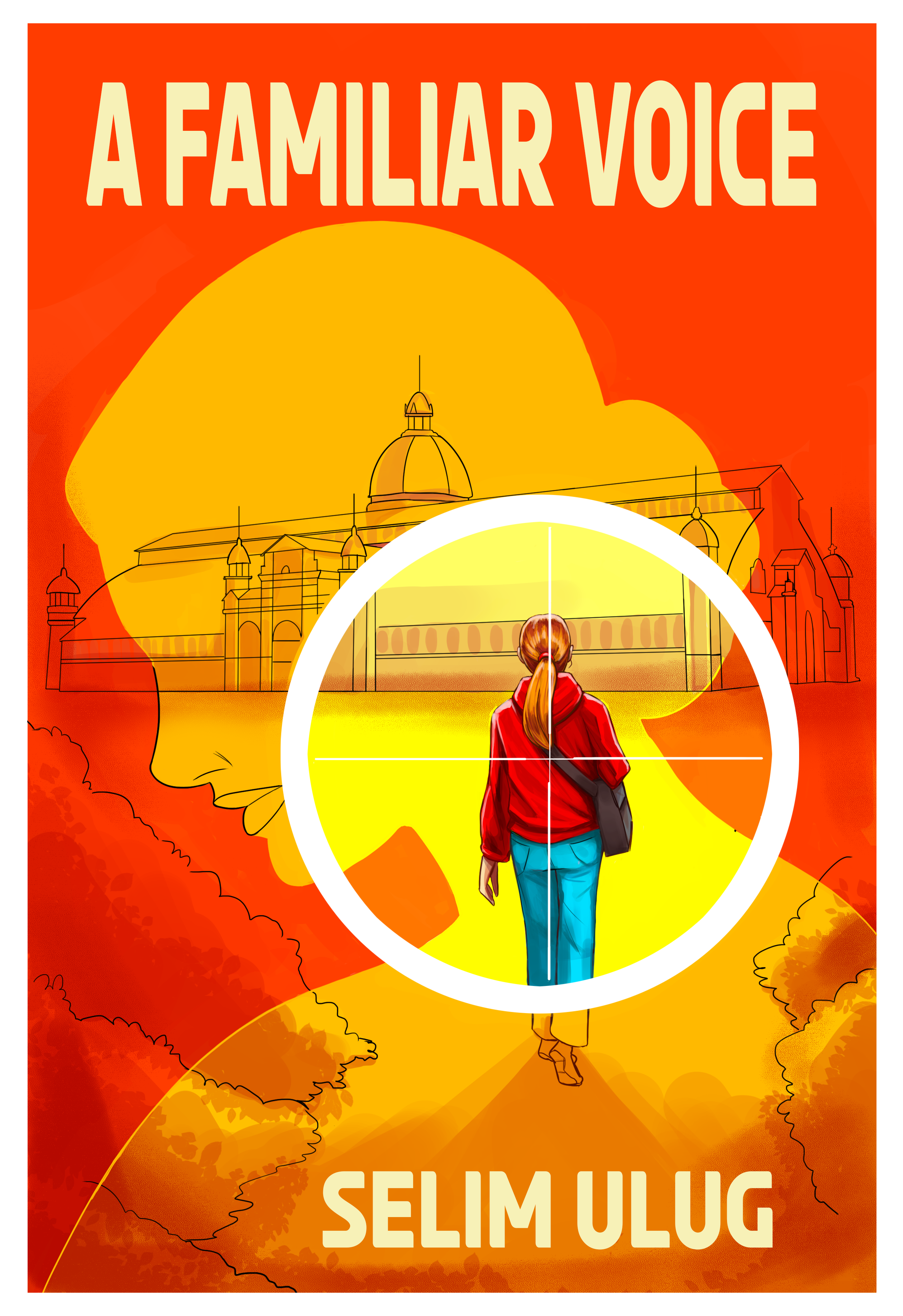
At some point, maybe when the book was about half done, I wrote an outline of the last chapter. It helped reinforce in my mind what had to happen before I got there. It was quite a thing to finally reach that chapter and flesh it out. At around the same time I commissioned Georgia Cook—who I was aware of from her Big Finish Doctor Who stories—to provide a cover illustration. Having this in front of me proved quite inspiring. I didn’t post it online right away, but showed to family and friends, who all reacted the same way: it’s gorgeous!
The novel took me about three years to write. Not because I was writing great literature, but because I often wrote little more than a few sentences per day. Some days I didn’t write at all. I frequently read what had come before, so there was lots of chance to catch typos, plotting errors, and so on. It goes to show you, though, that you can finish a book even if you have little time to spend on it. I’m retired, so in theory there should be lots of time, but I never wanted writing to become a second career. It’s a hobby that I greatly enjoy. I found very quickly that if I forced myself to spend a given amount of time on it, that it wasn’t fun anymore. So, slow and steady it went until it was all done.
As I write, it’s all done except for the busy work. I hired an editor for my first short story collection, but realistically, a self-published book doesn’t make a lot of money. Having learned some important lessons from my editor the first time around, I’ve elected to edit my own writing. For better or for worse. And that’s what the last few weeks of the writing process has been: iterations of reviewing, revising, and repeating until I don’t find anything more I want to change. The last stage will be to work through Amazon’s KDP process to get the book up at their store.
If you’re working on a novel, I hope this helps in some small way and I wish you all the luck and success in the world.
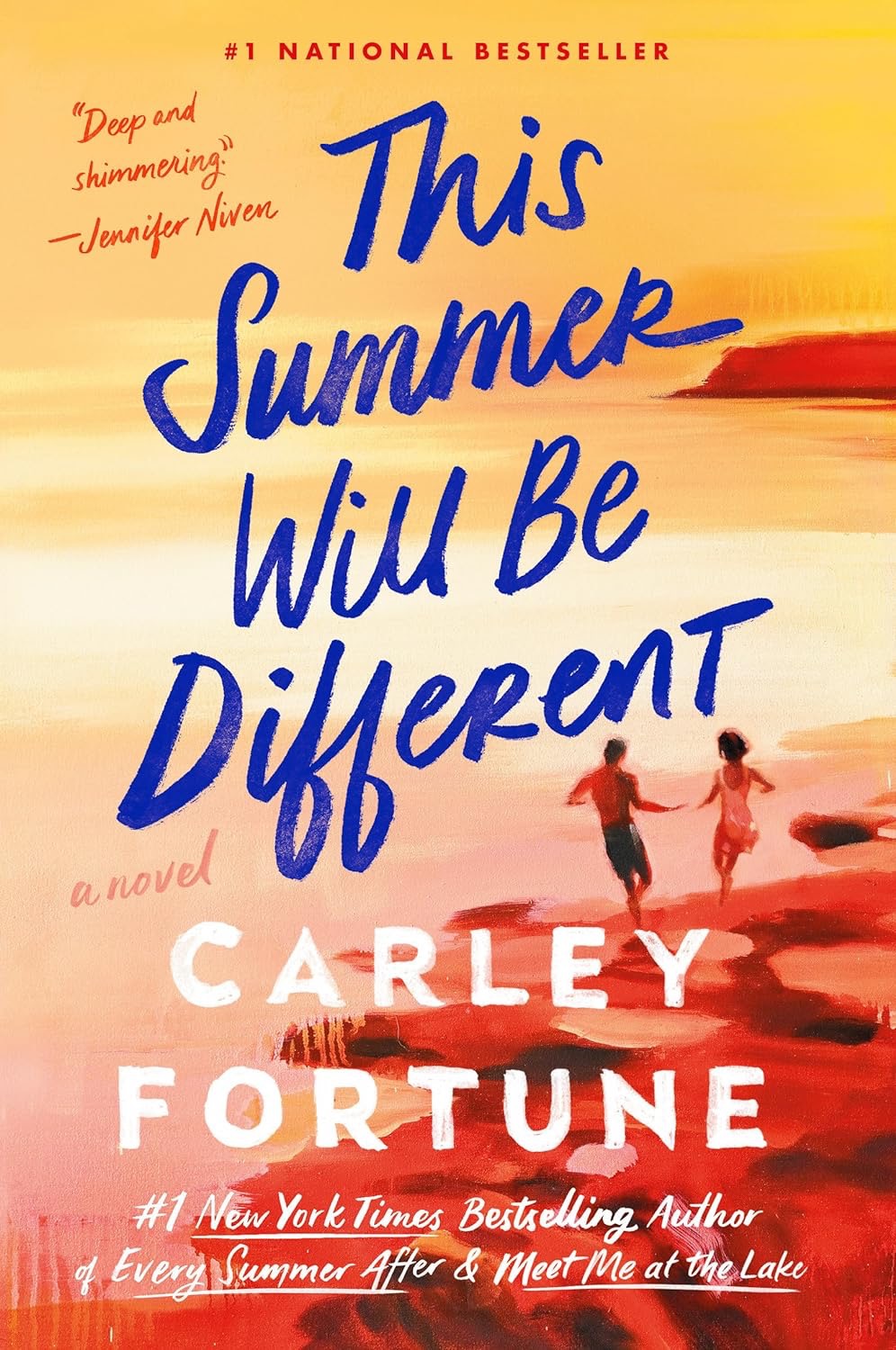
This Summer Will Be Different is a novel by Canadian writer Carley Fortune. More specifically, it’s a romance novel.
As you might know, romance isn’t my go-to genre. I explored romance a bit when I was trying to find myself as a writer. You see, my most popular fan fiction stories were the “mature” ones, the ones where amorous things happened. Was I a budding romance writer? After sampling a few novels in the genre, I decided that no, I wasn’t.
So, with that in mind, why did I choose to read this novel? And why did I enjoy it so much?
It started with an article on the CBC’s website about the author. Specifically, it was about Fortune’s use of setting to put the reader there, so that you see, smell, and feel the emotional reaction of the protagonist to the setting.
This interested me greatly. Even though my current project is a thriller, surely the thrill would only improve to the extent that the reader feels part of the action. If they are there.
The setting for This Summer Will Be Different is alternately Toronto and Prince Edward Island over the course of several years. When we meet PEI for the first time, it is described thusly:
Water glittering like sapphires beneath rust-coloured cliffs. Seaweed lying in knotty nests on a strip of sandy shoreline. A wood-sided restaurant. Stacks of lobster traps. A man in hip waders.
Sea brine filled my nose and the putt-putt of a fishing boat my ears. A salt-kissed breeze sent the skirt of my dress flapping against my calves, and I smiled.
This was protagonist Lucy Ashby’s first impression of PEI, and I think we’ve got pretty much all the senses accounted for. More importantly, you can imagine yourself right there with her. In the story, PEI is more than a place. It’s almost another character, one with the power to calm and heal.
In Toronto, Lucy, the owner of a flower shop, is always working, always micromanaging, always worrying. This contrasts to her time in PEI, where she can stop to breathe in the smells of the ocean and the local flowers and walk barefoot in the red-tinged sand. The contrast between the two settings is very effective.
As for the actual characters in Summer, I found them believable, fleshed-out, and three-dimensional. My only quibble is with Lucy’s love-to-be, who’s maybe too perfect, with his long, wavy hair, blue eyes, muscular, cleft in chin, facial stubble, and did he have washboard abs? Probably.
With Felix and Lucy, it was definitely a case of lust at first sight. But what about later? Their relationship has ups and downs and it feels believable. They both grow and change, but Lucy has the most growing up to do. In particular, she needs to work out how to let go, how to trust, and how to understand what she really wants from life.
A romance novel needs to be quite sensual, not just in terms of sex, but in the way it fills the senses. The smell of a place. The taste of the food. The sound of the surroundings. The pace is more leisurely and there’s space for a lot of description and internal monologue. As I mentioned, my current project is a thriller, a novel called A Familiar Voice. For a thriller, the pace is faster, and too much lingering, too much descriptive prose runs the risk of the reader losing interest.
It’s going to be interesting to find the right balance. I do want the novel to have a palpable sense of place, just as long as I can keep everyone interested in reading to find out what happens next.
I’m glad I read This Summer Will Be Different and encourage other writers to leave your comfort zone and treat your senses with this novel.


 SelimPensFiction