My new novel, a thriller called A Familiar Voice, is now available at your regional Amazon bookstore in eBook and paperback formats. If you should pick up a copy, I hope you enjoy it.
Amazon.ca
Amazon.com
Amazon.co.uk
Amazon.de
A Familiar Voice comes out in a few days, on the 18th of November. In the meantime, here’s a quick sample of what’s in store for Katy Lapointe.
After lunch, they put their clothes in the washing machine. Katy had just started the coffee maker when the doorbell rang.
“Katy Lapointe?” the woman said. She was wearing a dark business suit with her black hair pulled tightly into a bun. A leather satchel hung from her shoulder.
“Yes,” Katy said warily.
“Detective Jana Murty,” she said, flashing some identification. “May I come in?”
Katy, resigned to another grilling, opened the door further, stepped aside, and beckoned to the living room where her mother was already seated upon the sofa. Katy joined her, and the detective took a seat opposite.
“Mrs. Girard?” said the detective. Katy’s mother nodded.
“Are you here to blame us for getting shot at?” said Katy.
“Katy!” admonished her mother.
“It’s quite all right Mrs. Girard. No, that’s not why I’m here, though I’m curious why you would think that.”
“Sorry. The detective yesterday seemed to think we were as guilty as the guys that shot at us.”
“Well, allow me to apologize on their behalf,” said Detective Murty. “I’m afraid, though, that I will need you to run through what happened once more.”
With a sigh, Katy said, “Sure,” and she did so.
When she finished, the coffeemaker pinged. Katy’s mother looked towards the detective and asked, “Who would like some coffee?”
“That would be lovely, thanks,” said Murty. “With some cream, please, if you have it.”
“And I don’t have to ask you, Katy,” she said as she rose and went to the kitchen.
In a hushed voice, Detective Murty leaned forward and said to Katy, “If possible, I’d like to discuss something with you. Just you. It might be upsetting to your mother.”
This aroused Katy’s curiosity, and she nodded in response.
When her mother returned with a tray of coffees and cream for her and the detective, Katy said, “Thanks, Maman. I can take care of the rest of the detective’s questions if you wanted to get back to your housework.”
She glanced towards the detective. Upon Murty nodding in agreement, she said, “Merci,” left the living room, and took the stairs to the second floor to resume her vacuuming.
“How much does your mother know about your troubles of earlier this year?”
“Troubles,” said Katy. “That’s one way of putting it. All she knows is that I was attacked in a parking lot. There was no keeping that from her once the video went viral. She doesn’t know anything else. She would freak right out.”
“I thought as much,” said Murty. “I wouldn’t have told my mother either. In fact, there are a lot of things that happen in this job that I can’t share with her. That’s why I need to speak to you alone.”
Dipping into her shoulder bag, Murty retrieved a file folder, set it on the coffee table, and opened it, flipping through the pages of text and photographs.
“You were identified as a person of interest in an industrial espionage case. And then as a person of interest in the murders of Marvin Benett and Jim Coban. You were released, and then you goaded Robert Johnson into sending the real killer after you. He attacked you and that attack was, coincidentally you claim, caught on video. Is that an accurate summary?”
“I suppose. You missed the part where I was nearly killed in my own home. And it was all a bit more upsetting than your summary might imply. I mean, Marv was one of my best friends.”
“Of course. You must be an amazingly strong person to come through an experience like that and still be as well-adjusted as you seem to be.”
Katy couldn’t help but smile. “Heavy drinking helps.”
“I suspect it’s a bit more than that.” Here, Murty paused and seemed to assess Katy. When she continued, she said, “I’m very sorry to tell you that what happened yesterday might be related to that case.”
Katy felt a surge of dread. “How? We took down all the players. I figured yesterday was road rage or some such thing.”
“And they just happened to have ski masks in the car this time of year? But it’s not just that. Last week, Bernard Ladouceur was killed in a prison fight. And this morning, Robert Johnson was found dead in his cell.”
Katy felt herself turning pale. Ladouceur had been the hands-on muscle. He’d killed Marv. He’d also killed Hitesh Varma, the marketing director at Davidson, and Jim Coban, the marketing director at her company. And he had tried to kill her. Twice. As for Johnson, Katy and he were former colleagues and friends. Unfortunately, he had been responsible for the whole nasty business. Taking him down had been bittersweet. “How did it happen?”
“He was found with a shiv sticking out of his jugular.”
“Well, that would do it.” Katy, thinking furiously, considering the implications. There was really only one conclusion, and she hated it: “Someone is tidying up loose ends.”
“Exactly,” Murty nodded. “Now, it’s still possible that these are coincidences, but if you put them together with what happened yesterday—”
“Then,” said Katy, finishing the sentence, “I’m another loose end.”
“And if that’s true, your mother’s not safe, not if you stay here.” While Katy digested that, Murty continued. “We can arrange protective custody, but at the very least I think you need to get out of this house.”
“Agreed,” said Katy, getting to her feet. “But ixnay on the protective custody. I can take care of myself.”
The detective smiled. “I thought you might say that, but the offer stands.” After handing Katy her business card, she added “My cell phone number is there. Call anytime. I mean it. And please take a card for your mother, just in case.”
“I do appreciate it, really I do,” said Katy, taking the cards. “Will you let me know if you find out anything?”
“For sure. But please exercise extreme caution. There’s no way of knowing when your friends from yesterday will be back, but you can be sure they’ll be back sometime.”
If, like me, you’ve read several books about how to write a novel, you’ll know that there are about as many writing processes as there are writers. In this post, I’ll try to tell you about mine. But take it with a grain of salt. After all, I’ve only written one novel. I may need to update this post after my second.
The first thing you should know about me is that, in my working career, I worked in a number of roles centered around software development. Back in the old days, project teams used a software development process called the waterfall method. First, you figured out what the software was supposed to do. This was documented as a set of requirements. Next you designed the software to do what it was supposed to, and your design would be developed in increasingly detailed layers until, at the most detailed layer, it was ready to be implemented in software. When the software was finished, it was tested. Seems reasonable.
The problem is that, in practice, the waterfall method didn’t work very well. It was all too often the case that the requirements needed to change along the way. When they did, any design and implementation affected by the change would need to be re-worked. Change was expensive and led to conflicts between the developer and the customer. Another problem was that, sometimes, when you got down to the nitty gritty of writing the software, you realized that, well, it wasn’t going to work. The design might have to be revisited. Maybe the requirements as well.
It was much better to take an iterative approach: identify some key requirements, come up with a software design “scaffolding,” and design and implement some of the key features. Each iteration focused on some number of features. You continue, refining requirements or adding new ones, doing some design, doing some implementation. Experience showed that it was much more effective to develop software this way. When requirements changed, and they almost always change, the cost was much less than if the waterfall process had been in play.
All well and good. So what does this have to do with novel writing? I’m sure you seen that some writers are “plotters” and some are “pantsers.” The former plot out the story in exacting detail. The latter write by the seat of their pants without a firm idea of where they are going.
My writing process was somewhere in the middle, and bears some resemblance to the iterative software development process. I started with the fact that this book was going to be a thriller. It had to be fast-paced, but not exhausting. In other words, action, break, action, break, as a kind of overarching structure. An architectural scaffolding, if you like.
I like to distinguish plot–what happens–versus what the story is actually about. The theme, in other words. I knew early on that I wanted one of the themes to be about family. Later on, I realized that mothers and daughters was going to be another theme. Another theme, the evolution of friendship, emerged later still. The point is, that even the themes were developed dynamically. In some cases, I knew what I was shooting for from the start, and other themes emerged through the writing. In those cases, I would retcon earlier chapters to support a new theme.
While I knew roughly where I wanted the story to end up, the road taking me there was quite dynamic. For instance, I was goofing around with my son, trading a pair of cool looking sunglasses. When I put them on, I looked in the mirror and said, “Maximum cool!” And then I dared myself to add a character to the book called Max Cool. After a bit of research, I found that Kool was a legit last name, so Max Cool became Max Kool, a construction foreman who instructs Katy on self defence techniques.
I kept a separate notes file, in which I jotted down questions to myself, possible directions in which to take the story, and even who the main villain would turn out to be, and whether a given character was good or evil. Also, there was a preliminary chapter breakdown, with just a sentence describing where I wanted a given chapter to take the story. This was fluid, but it was a kind of structure to get me started.
The story is set in 2021, and in the world of the story COVID never happened. Who wants to live through that again? One of the notes I made to myself was I was writing was to incorporate news stories from that time. The thought was that this would more firmly place the story in 2021. But virtually every headline that year was related to COVID, so you won’t see current events colouring the text.
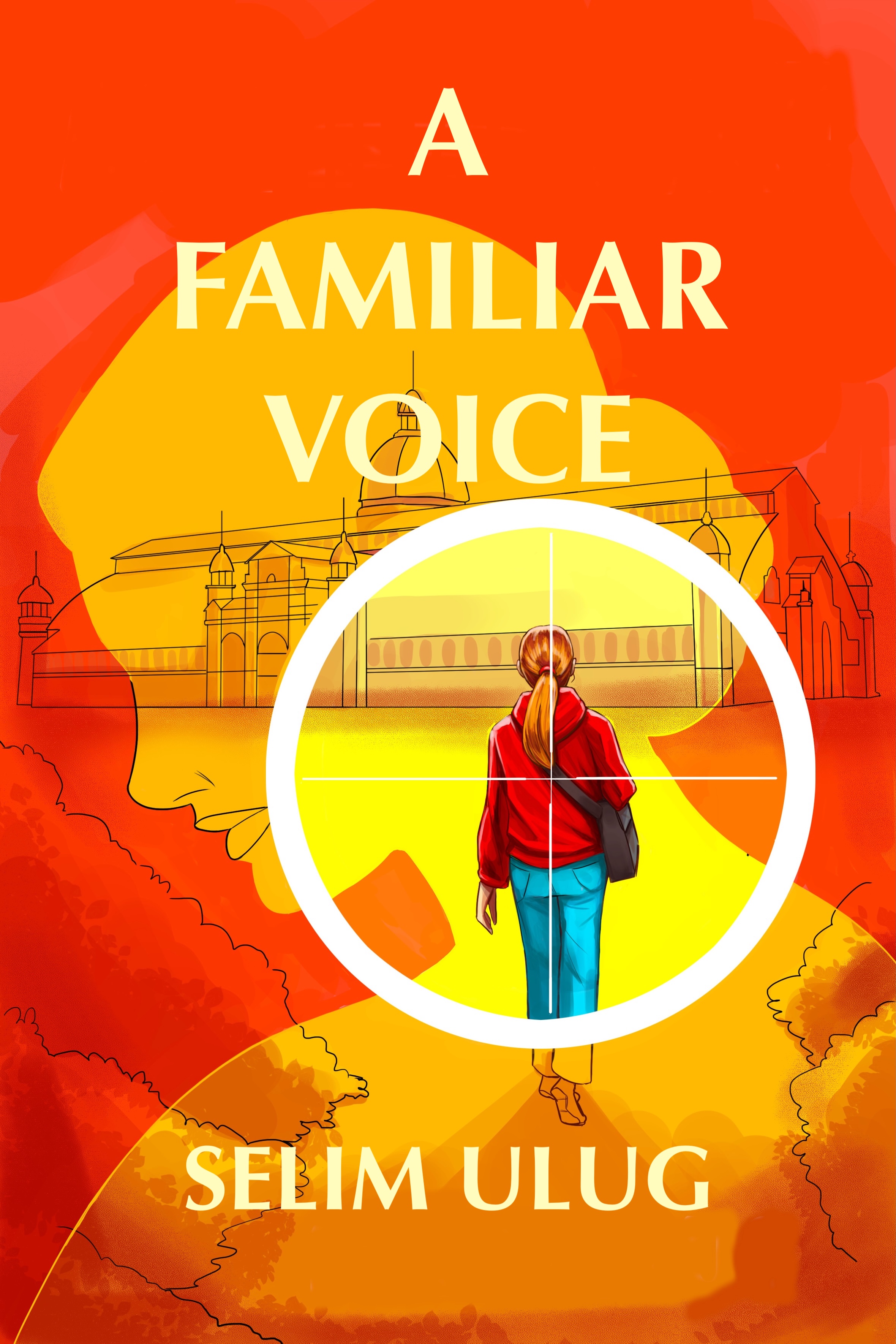
At some point, maybe when the book was about half done, I wrote an outline of the last chapter. It helped reinforce in my mind what had to happen before I got there. It was quite a thing to finally reach that chapter and flesh it out. At around the same time I commissioned Georgia Cook—who I was aware of from her Big Finish Doctor Who stories—to provide a cover illustration. Having this in front of me proved quite inspiring. I didn’t post it online right away, but showed to family and friends, who all reacted the same way: it’s gorgeous!
The novel took me about three years to write. Not because I was writing great literature, but because I often wrote little more than a few sentences per day. Some days I didn’t write at all. I frequently read what had come before, so there was lots of chance to catch typos, plotting errors, and so on. It goes to show you, though, that you can finish a book even if you have little time to spend on it. I’m retired, so in theory there should be lots of time, but I never wanted writing to become a second career. It’s a hobby that I greatly enjoy. I found very quickly that if I forced myself to spend a given amount of time on it, that it wasn’t fun anymore. So, slow and steady it went until it was all done.
As I write, it’s all done except for the busy work. I hired an editor for my first short story collection, but realistically, a self-published book doesn’t make a lot of money. Having learned some important lessons from my editor the first time around, I’ve elected to edit my own writing. For better or for worse. And that’s what the last few weeks of the writing process has been: iterations of reviewing, revising, and repeating until I don’t find anything more I want to change. The last stage will be to work through Amazon’s KDP process to get the book up at their store.
If you’re working on a novel, I hope this helps in some small way and I wish you all the luck and success in the world.
I’ve mentioned in other posts that I’m working on a novel called A Familiar Voice. I can finally announce that it will be available in November. Here’s the beautiful cover art by the omni-talented Georgia Cook.
A Familiar Voice is a sequel to the novelette “A Voice” which appeared in my short story collection, Something Special. The book includes a slightly revised version of that story as well as the novel.
What’s it about, you ask?
When the men responsible for trying to frame—and kill—Katy LaPointe were arrested, she breathed a sigh of relief and thought that her troubles were over. For a time, they were. But a failed drive-by shooting makes Katy realize that her troubles are just beginning.
Meanwhile, Laura Seeback, a high school teacher, needs help, even if she doesn’t know it. A familiar voice tells Katy that she can help herself by helping Laura. As the attempts on their lives become more desperate, can Katy and Laura stay alive—and out of jail—long enough to find out who wants them dead?
In other words, A Familiar Voice is a thriller. This is my first novel, after having written many short stories. In a future post, I’ll talk about the experience and process of novel writing.