Tag Archives: Una McCormack

Star Trek: Strange New Worlds: Asylum

Star Trek: Strange New Worlds: Asylum, by Una McCormack, is the third Star Trek audio book I’ve listened to this year. It is very much a character-based story, and features Una Chin-Riley in two time periods: on the “present day” Enterprise with Christopher Pike in command, and 25 years earlier, when Chin-Riley was a senior cadet at Starfleet Academy.

As an aside, I’m glad they gave Number One a name—really, they had to, didn’t they?—and I think they picked a perfect name, but after decades of knowing her as Number One, referring to her as Una is, well, a process.

Back at Starfleet Academy, Ensign Christopher Pike, who is on leave pending an investigation of an incident in which he was involved, is giving some lectures on what life is really like “out there.” Pelia, who is one of Chin-Riley’s instructors, encourages her to sit in on Pike’s lectures. She does so, and after a rocky start, they become fast friends.

Meanwhile, Chin-Riley’s roommate is involved with Federation asylum seekers, specifically, a family of Euxhana, a cultural and ethnic minority on Chionia. When Chin-Riley learns about them, she becomes interested and gets involved as well. In the present day, the Enterprise is hosting trade negotiations between the Federation and the Chionian government. And here is where the underlying theme of this book comes in. For the treatment of the Euxhana reflects the treatment of Indigenous peoples in North America, with the Chionians removing the Euxhana from their traditional territories, and attempting to erase their culture and language. The difference is that the treatment of our Indigenous peoples was much worse.

It is worth pointing out that, since the beginning, Star Trek has been a vehicle for exploring social issues of the day. At the time, they got away with it because it was set in space in the future, not Earth in the 20th Century. So, there were episodes dealing with racism, mutual assured destruction, the impact of artificial intelligence, and others. In fact, every time Uhuru appeared onscreen in the 1960’s, a Black woman on the bridge of a starship, that was social commentary. It’s also worth pointing out that “Asylum” isn’t the first Star Trek story to deal with the treatment of Indigenous peoples. This was also explored in the Next Generation episode, “Journey’s End.” To sum up, if you prefer your Star Trek to be free of social commentary, this isn’t the story for you. But if, like me, you feel that social commentary is at the heart of Star Trek, you’ll be well rewarded.

In the present day, Chin-Riley tries very hard to put right a bad choice she made in the academy with regard to the Euxhana refugees. This is the tension at the heart of the story and contributes to the immense readability of this well-written book.

Meanwhile, the audio version of Asylum is ably narrated by Robert Petkoff. Among his many voices, he captures the cool-under-fire persona of Christopher Pike particularly well. Also, believe it or not, he does an amazing Pelia. Overall, his narration is excellent and highly recommended, as is the book as a whole.
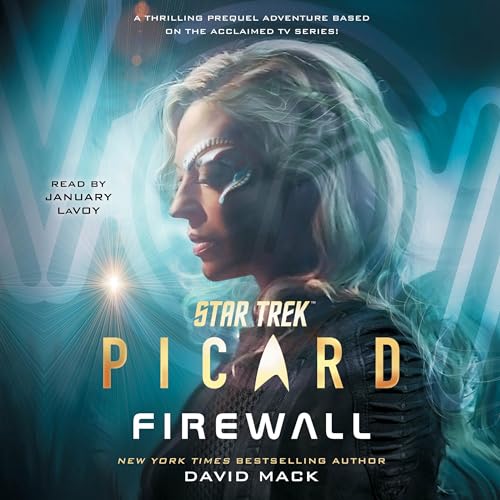
Star Trek Picard: Firewall

A woman walks into a bar and inquires of the Fenris Ranger therein how she herself might join the rangers.

This is how David Mack’s Star Trek Picard: Firewall opens. The novel bears some comparison to Una McCormack’s Star Trek Picard: Second Self, which I wrote about previously. Like Second Self, the audio version of Firewall is narrated by January LaVoy, the extraordinary narrator of a thousand voices. Her Kathryn Janeway is so authentic you’d be forgiven for thinking they’d brought in Kate Mulgrew to speak the part. Not only can she pull off many voices, but LaVoy is an amazing actor who delivers a full gamut of emotions.

Star Trek Picard: Firewall

As I’ve mentioned before, I’m not generally a fan of spin-off novels. But, like Second Self, Firewall very pleasantly surprised me. It’s reads like it’s written for adults with some very mature themes, including genocide and food as a weapon. Both remain depressingly apropos to the times in which we live.

Whereas Second Self is concerned with Raffi (Raffaela Musiker), Firewall explores the history of the other side of the coin, Seven of Nine, and takes us from Voyager’s return up to the events of Star Trek Picard. Seven of Nine’s growth is a joy to behold. Early on, we see her at her lowest: rejected from Star Fleet Academy because of her history with the Borg; lost; working at menial jobs; seeking human contact in whatever form she can. Things change when she becomes involved with a Fenris Ranger operation. She begins to grow personally, as a tactician, and as a leader. She comes to believe in her own competency.

I appreciate the fact that, for the vast majority of the book, there are few prerequisites. It is helpful to know something about Seven of Nine from her time on Voyager, and her relationship with Captain Janeway. Still, there’s a reveal in the book and I could tell it was meant to be a big deal. Sadly, it went right over my head. My reaction was, Huh? I’m a fan, you see, but not a “super” fan. Not of Star Trek or any other fandom, to be honest. Thankfully, we have the Memory Alpha wiki and that set that to rights.

The bottom line is that I highly recommend Star Trek Picard: Firewall. The prose is a pleasure to read, and the story is very exciting and very touching. And it’s Star Trek. What more could you ask for?

Star Trek Picard: Second Self

I knew a guy who, before purchasing a book, read the last couple of pages. Why would you do that? I asked him. Wouldn’t that spoil the whole thing? Because, he said, why would I read a book if I don’t like the ending?

Fast forward to the present, where I’ve been listening to January LaVoy’s narration of Una McCormack’s Star Trek Picard: Second Self. I started at the beginning, but even before reaching the end, I knew that I could recommend this book without hesitation. Doubly true now that I’ve listened to the whole thing.

To be honest, I don’t often enjoy spin-off novels. There are exceptions, most notably Timothy Zahn’s Thrawn trilogy. And there are others I’ve enjoyed, including some Star Trek and Doctor Who novels, but Second Self is something special. Why is that?

Well, for one thing, it’s clearly a book for adults, or at least for the older YA crowd, with its mature themes of war-time atrocities and drug addiction. This book has other things going for it. Motivations are clear. There is a lot of inner dialog which expands our appreciation of Raffi’s (Raffaela Musikerz) character. Backstory, of which Star Trek has untold volumes, is provided as required without overwhelming the current story.

Second Self concerns Raffi, who, at the behest of Admiral Jean-Luc Picard, undertakes an off-books mission to bring a war criminal to justice. The problem is, intelligence reports have the criminal last seen on Ordeve, a planet with which Raffi has unhappy associations. The focus of the book later shifts to Raffi’s earlier time on Ordeve, and then to events that occurred before that. It’s a good story-telling technique, motivating us to understand what went before.

Aside from the very effective prose, there’s January LaVoy’s exquisite narration, with so many voices that you’d almost swear that this was a full-cast audio. I’ll be looking for more audio books narrated by this voice actor.

To be honest, I picked up this audio book because it was on sale. Now that I’ve listened to it, I would happily pay full price. Pick up a copy or listen to the audio version. If you enjoy Star Trek, you’ll be glad you read Second Self.