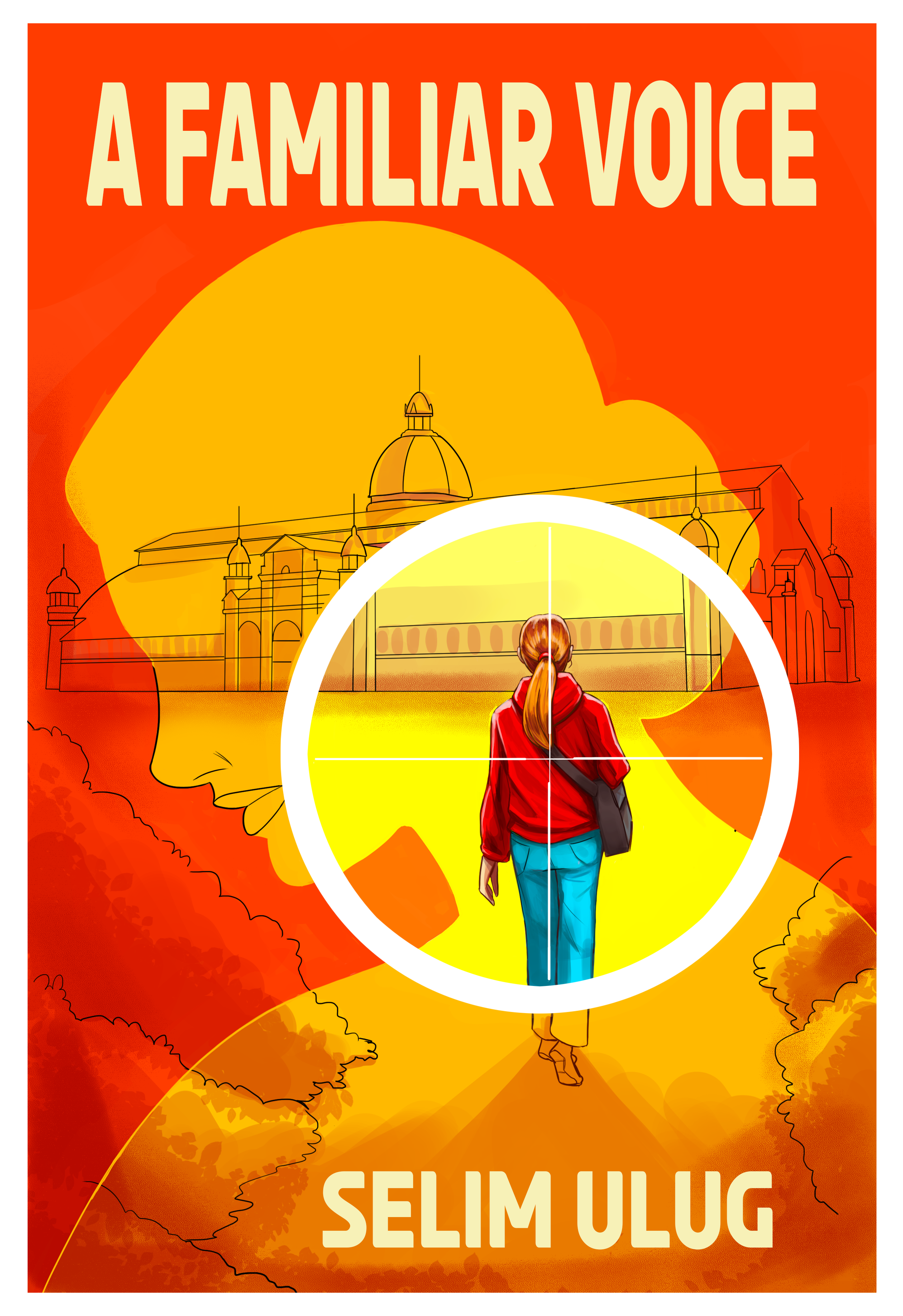
My new novel, a thriller called A Familiar Voice, is now available at your regional Amazon bookstore in eBook and paperback formats. If you should pick up a copy, I hope you enjoy it.
Amazon.ca
Amazon.com
Amazon.co.uk
Amazon.de
A Familiar Voice comes out in a few days, on the 18th of November. In the meantime, here’s a quick sample of what’s in store for Katy Lapointe.
After lunch, they put their clothes in the washing machine. Katy had just started the coffee maker when the doorbell rang.
“Katy Lapointe?” the woman said. She was wearing a dark business suit with her black hair pulled tightly into a bun. A leather satchel hung from her shoulder.
“Yes,” Katy said warily.
“Detective Jana Murty,” she said, flashing some identification. “May I come in?”
Katy, resigned to another grilling, opened the door further, stepped aside, and beckoned to the living room where her mother was already seated upon the sofa. Katy joined her, and the detective took a seat opposite.
“Mrs. Girard?” said the detective. Katy’s mother nodded.
“Are you here to blame us for getting shot at?” said Katy.
“Katy!” admonished her mother.
“It’s quite all right Mrs. Girard. No, that’s not why I’m here, though I’m curious why you would think that.”
“Sorry. The detective yesterday seemed to think we were as guilty as the guys that shot at us.”
“Well, allow me to apologize on their behalf,” said Detective Murty. “I’m afraid, though, that I will need you to run through what happened once more.”
With a sigh, Katy said, “Sure,” and she did so.
When she finished, the coffeemaker pinged. Katy’s mother looked towards the detective and asked, “Who would like some coffee?”
“That would be lovely, thanks,” said Murty. “With some cream, please, if you have it.”
“And I don’t have to ask you, Katy,” she said as she rose and went to the kitchen.
In a hushed voice, Detective Murty leaned forward and said to Katy, “If possible, I’d like to discuss something with you. Just you. It might be upsetting to your mother.”
This aroused Katy’s curiosity, and she nodded in response.
When her mother returned with a tray of coffees and cream for her and the detective, Katy said, “Thanks, Maman. I can take care of the rest of the detective’s questions if you wanted to get back to your housework.”
She glanced towards the detective. Upon Murty nodding in agreement, she said, “Merci,” left the living room, and took the stairs to the second floor to resume her vacuuming.
“How much does your mother know about your troubles of earlier this year?”
“Troubles,” said Katy. “That’s one way of putting it. All she knows is that I was attacked in a parking lot. There was no keeping that from her once the video went viral. She doesn’t know anything else. She would freak right out.”
“I thought as much,” said Murty. “I wouldn’t have told my mother either. In fact, there are a lot of things that happen in this job that I can’t share with her. That’s why I need to speak to you alone.”
Dipping into her shoulder bag, Murty retrieved a file folder, set it on the coffee table, and opened it, flipping through the pages of text and photographs.
“You were identified as a person of interest in an industrial espionage case. And then as a person of interest in the murders of Marvin Benett and Jim Coban. You were released, and then you goaded Robert Johnson into sending the real killer after you. He attacked you and that attack was, coincidentally you claim, caught on video. Is that an accurate summary?”
“I suppose. You missed the part where I was nearly killed in my own home. And it was all a bit more upsetting than your summary might imply. I mean, Marv was one of my best friends.”
“Of course. You must be an amazingly strong person to come through an experience like that and still be as well-adjusted as you seem to be.”
Katy couldn’t help but smile. “Heavy drinking helps.”
“I suspect it’s a bit more than that.” Here, Murty paused and seemed to assess Katy. When she continued, she said, “I’m very sorry to tell you that what happened yesterday might be related to that case.”
Katy felt a surge of dread. “How? We took down all the players. I figured yesterday was road rage or some such thing.”
“And they just happened to have ski masks in the car this time of year? But it’s not just that. Last week, Bernard Ladouceur was killed in a prison fight. And this morning, Robert Johnson was found dead in his cell.”
Katy felt herself turning pale. Ladouceur had been the hands-on muscle. He’d killed Marv. He’d also killed Hitesh Varma, the marketing director at Davidson, and Jim Coban, the marketing director at her company. And he had tried to kill her. Twice. As for Johnson, Katy and he were former colleagues and friends. Unfortunately, he had been responsible for the whole nasty business. Taking him down had been bittersweet. “How did it happen?”
“He was found with a shiv sticking out of his jugular.”
“Well, that would do it.” Katy, thinking furiously, considering the implications. There was really only one conclusion, and she hated it: “Someone is tidying up loose ends.”
“Exactly,” Murty nodded. “Now, it’s still possible that these are coincidences, but if you put them together with what happened yesterday—”
“Then,” said Katy, finishing the sentence, “I’m another loose end.”
“And if that’s true, your mother’s not safe, not if you stay here.” While Katy digested that, Murty continued. “We can arrange protective custody, but at the very least I think you need to get out of this house.”
“Agreed,” said Katy, getting to her feet. “But ixnay on the protective custody. I can take care of myself.”
The detective smiled. “I thought you might say that, but the offer stands.” After handing Katy her business card, she added “My cell phone number is there. Call anytime. I mean it. And please take a card for your mother, just in case.”
“I do appreciate it, really I do,” said Katy, taking the cards. “Will you let me know if you find out anything?”
“For sure. But please exercise extreme caution. There’s no way of knowing when your friends from yesterday will be back, but you can be sure they’ll be back sometime.”
If, like me, you’ve read several books about how to write a novel, you’ll know that there are about as many writing processes as there are writers. In this post, I’ll try to tell you about mine. But take it with a grain of salt. After all, I’ve only written one novel. I may need to update this post after my second.
The first thing you should know about me is that, in my working career, I worked in a number of roles centered around software development. Back in the old days, project teams used a software development process called the waterfall method. First, you figured out what the software was supposed to do. This was documented as a set of requirements. Next you designed the software to do what it was supposed to, and your design would be developed in increasingly detailed layers until, at the most detailed layer, it was ready to be implemented in software. When the software was finished, it was tested. Seems reasonable.
The problem is that, in practice, the waterfall method didn’t work very well. It was all too often the case that the requirements needed to change along the way. When they did, any design and implementation affected by the change would need to be re-worked. Change was expensive and led to conflicts between the developer and the customer. Another problem was that, sometimes, when you got down to the nitty gritty of writing the software, you realized that, well, it wasn’t going to work. The design might have to be revisited. Maybe the requirements as well.
It was much better to take an iterative approach: identify some key requirements, come up with a software design “scaffolding,” and design and implement some of the key features. Each iteration focused on some number of features. You continue, refining requirements or adding new ones, doing some design, doing some implementation. Experience showed that it was much more effective to develop software this way. When requirements changed, and they almost always change, the cost was much less than if the waterfall process had been in play.
All well and good. So what does this have to do with novel writing? I’m sure you seen that some writers are “plotters” and some are “pantsers.” The former plot out the story in exacting detail. The latter write by the seat of their pants without a firm idea of where they are going.
My writing process was somewhere in the middle, and bears some resemblance to the iterative software development process. I started with the fact that this book was going to be a thriller. It had to be fast-paced, but not exhausting. In other words, action, break, action, break, as a kind of overarching structure. An architectural scaffolding, if you like.
I like to distinguish plot–what happens–versus what the story is actually about. The theme, in other words. I knew early on that I wanted one of the themes to be about family. Later on, I realized that mothers and daughters was going to be another theme. Another theme, the evolution of friendship, emerged later still. The point is, that even the themes were developed dynamically. In some cases, I knew what I was shooting for from the start, and other themes emerged through the writing. In those cases, I would retcon earlier chapters to support a new theme.
While I knew roughly where I wanted the story to end up, the road taking me there was quite dynamic. For instance, I was goofing around with my son, trading a pair of cool looking sunglasses. When I put them on, I looked in the mirror and said, “Maximum cool!” And then I dared myself to add a character to the book called Max Cool. After a bit of research, I found that Kool was a legit last name, so Max Cool became Max Kool, a construction foreman who instructs Katy on self defence techniques.
I kept a separate notes file, in which I jotted down questions to myself, possible directions in which to take the story, and even who the main villain would turn out to be, and whether a given character was good or evil. Also, there was a preliminary chapter breakdown, with just a sentence describing where I wanted a given chapter to take the story. This was fluid, but it was a kind of structure to get me started.
The story is set in 2021, and in the world of the story COVID never happened. Who wants to live through that again? One of the notes I made to myself was I was writing was to incorporate news stories from that time. The thought was that this would more firmly place the story in 2021. But virtually every headline that year was related to COVID, so you won’t see current events colouring the text.
At some point, maybe when the book was about half done, I wrote an outline of the last chapter. It helped reinforce in my mind what had to happen before I got there. It was quite a thing to finally reach that chapter and flesh it out. At around the same time I commissioned Georgia Cook—who I was aware of from her Big Finish Doctor Who stories—to provide a cover illustration. Having this in front of me proved quite inspiring. I didn’t post it online right away, but showed to family and friends, who all reacted the same way: it’s gorgeous!
The novel took me about three years to write. Not because I was writing great literature, but because I often wrote little more than a few sentences per day. Some days I didn’t write at all. I frequently read what had come before, so there was lots of chance to catch typos, plotting errors, and so on. It goes to show you, though, that you can finish a book even if you have little time to spend on it. I’m retired, so in theory there should be lots of time, but I never wanted writing to become a second career. It’s a hobby that I greatly enjoy. I found very quickly that if I forced myself to spend a given amount of time on it, that it wasn’t fun anymore. So, slow and steady it went until it was all done.
As I write, it’s all done except for the busy work. I hired an editor for my first short story collection, but realistically, a self-published book doesn’t make a lot of money. Having learned some important lessons from my editor the first time around, I’ve elected to edit my own writing. For better or for worse. And that’s what the last few weeks of the writing process has been: iterations of reviewing, revising, and repeating until I don’t find anything more I want to change. The last stage will be to work through Amazon’s KDP process to get the book up at their store.
If you’re working on a novel, I hope this helps in some small way and I wish you all the luck and success in the world.
If you remember my short story collection, Something Special, then you might remember a story therein called “Remember Me?” It was one of my favourites.
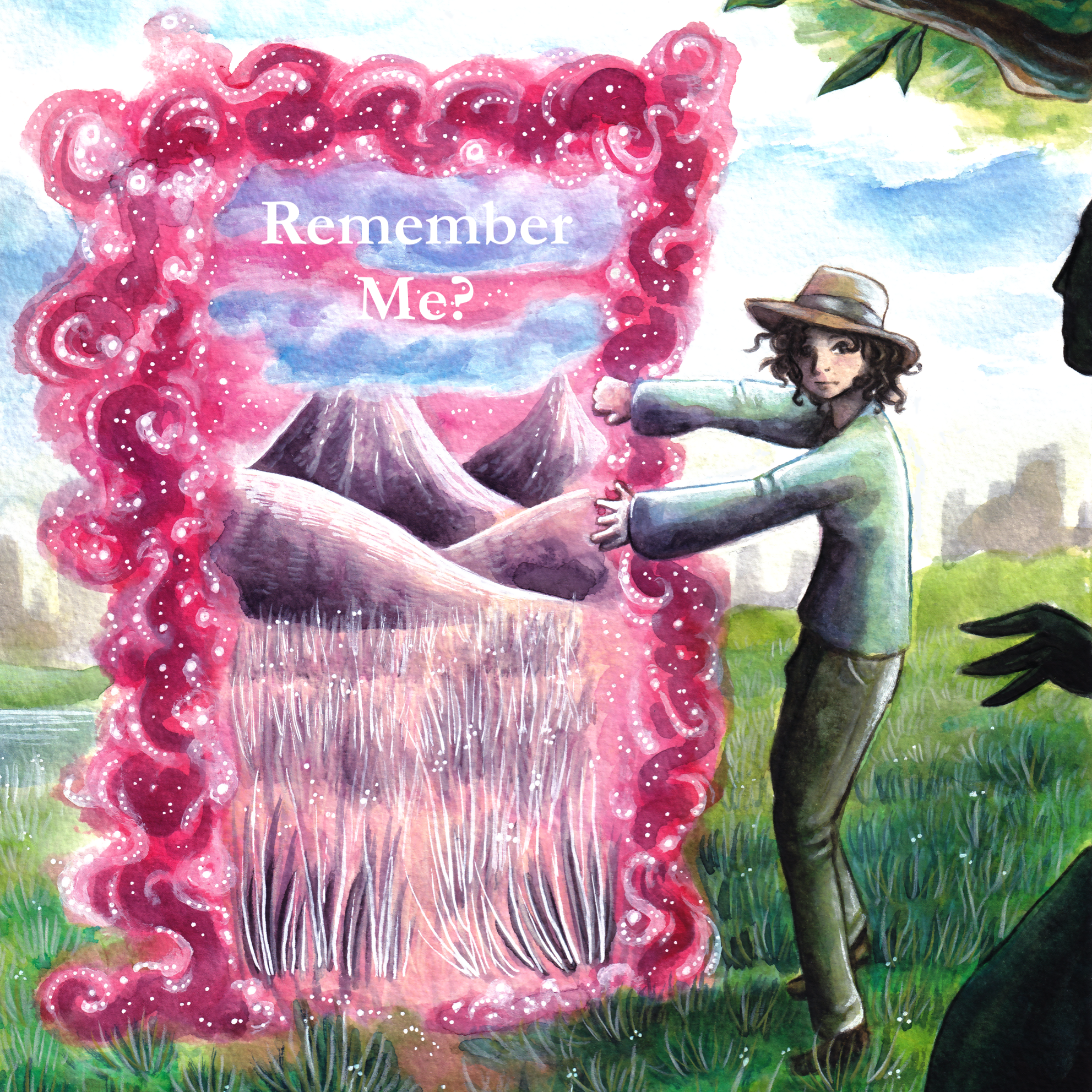
The story concerns Will Fallon, a man muddling his way through life, and his encounter with Susan Follows, a woman who claims she can travel between worlds. Susan wants to take Will’s cat away.
Puzzled at his lack of success with relationships, Will isn’t quick to trust. “Remember Me?” is really about him learning to open up to people and to the wonders in our every day lives.
I first envisioned “Remember Me?” as a Doctor Who story from the point of view of a companion who gets left behind. But that was just the begining. I wanted to do more with the story, take it in a different direction.
The Something Special version of the story is set in Kingston, Ontario. When TT Productions 23 agreed to produce an audio version, I moved the setting to London, UK, and Will meets Susan in Kensington Park near the statue of Peter Pan, a location that I adore.
The audio version is otherwise nearly identical to the original, with the exception of an opening scene that I added to set the stage for what was to come.
Abi Louise, TT Producer and jack-of-all-trades extraordinaire, assembled a small but stellar cast, including Connor Sumner, Vanessa McAuley, and Ellaika Villegas. They nailed their lines on the first take. As is often the case, the actors breathed new life into the story, in ways that I found surprisingly touching. I mean, considering that I wrote the thing.
I hope you give the audio a listen and if you like it, please tell your friends. If you’d like to learn what happens next, there’s a sequel to “Remember Me?” in my second collection, The Woman in Red.
Something Special audio on YouTube
Something Special and The Woman in Red are available at your regional Amazon store. Go to the store and search for “Selim Ulug.”

So a few days ago Grego Keith contacted me and expressed interest in having a chat as part of a collection of interviews on the Time Scales YouTube channel. The Time Scales is a website where users can comment on and rate, well, all sorts of things, including Doctor Who TV and audio episodes.
Me being me, I first checked who else Grego had been speaking to. When I saw that the list included Gary Russell, my first reaction was, well why does he want to speak to me? There are a lot of other well known faces there, including Sophie Aldred. My second reaction was to say, sure, let’s chat.
Grego was extremely welcoming and put me right at ease, which was great because I get awfully nervous about this kind of thing. The last time I’d been interviewed was around the time that Big Finish announced “Battle Scars” back in 2019. Before the world changed.
We ended up having a great chat and I thoroughly enjoyed the experience. We covered my writing journey, starting with sketches I would write as a kid, to my fan fiction, to Big Finish, and to the collections of original fiction I’ve self-published. We also touched on the two Alternative War fan audios that were recently released by TT Productions 23.
I hope you give the video a watch when you get the chance. And be sure to check out the other content in the Time Scale’s channel. I’ve just finished the first part of the Gary Russell interview and am looking forward to parts two and three.
Oh yes. Happy Doctor Who Podcast Day!
We met Will Fallon in the short story “Remember Me?” in my collection Something Special. Will encounters a woman named Susan Follows who can travel between worlds and who has come looking for his cat, Sam. Sam, it turns out, isn’t from around here. And in the world from which she came, she can talk. Will and Sam travel with Susan to many worlds until they end up back home, and Susan continues her travels on her own.
“Happy Enough”, a sequel to this story, appears in my new collection , The Woman in Red. In this excerpt, Will Fallons encounters someone who shouldn’t exist–a fictional character of his own making.

The second incident happened on Tuesday of the following week while Della was away at a conference. I was to meet some friends at a nearby Irish pub that evening. Being the first to arrive, I scanned the patio for a free table. They were all occupied and I was about to head indoors when a woman rose and walked towards the exit in my direction. I was about to thank her when I realized it was the dinosaur-dress woman from my story, “Under the Sand.” She was Black, her hair arranged in ringlets falling to her shoulders, and she wore a close-fitting cotton dress decorated with dinosaurs. I was stunned. Recovering a moment later, I decided what to say.
“Hi,” I said, when she was closer. “I was going to thank you for the table, but I think I know you.”
The woman said nothing, and instead raised a skeptical eyebrow. Interesting, I thought. If this is a show for my benefit, why does she look like I’ve just given her a lame pickup line?
“You work at FLIR, don’t you?” I continued. “I saw you speak at a defence conference.”
The skepticism on her face was quickly replaced by surprise.
“I’m Will Fallon. I used to work as a technical writer. You’re … Briana?”
“Briana Davison,” she said with a smile.
And that’s when the blood drained from my face. I hadn’t used her last name in the story, something that I’d kicked myself for. But that was the surname I’d chosen as part of her backstory, as was the defence conference. I had to force myself not to sway on my feet.
“Nice to meet you,” she continued. “You live in Kingston?”
“Um, yes. Are you here on business or sightseeing?”
“Bit of both. I’m collaborating with a professor at the Royal Military College. Well, I must get on. Nice to meet you, Will,” and she extended her hand.
“Same,” I mumbled, and we shook. Watching her leave, I whispered, “Stay clear of San Diego.” Then I took a seat at the empty table and ordered a large whiskey.
It was earlier than planned when I got home. Despite my best efforts, I’d only paid half-hearted attention to my friends, and when they noticed, I pleaded lack of sleep. Sam was waiting for me just inside the door. That was unusual. She went out most nights through a second-floor window that I keep open, leaping from the window ledge to the maple tree and returning home the same way.
Sam came up to me and rubbed her head against my leg. Kneeling down, I scratched behind her ears and looked into her eyes.
“You know, don’t you?” I said. “That something’s wrong. You always know.”
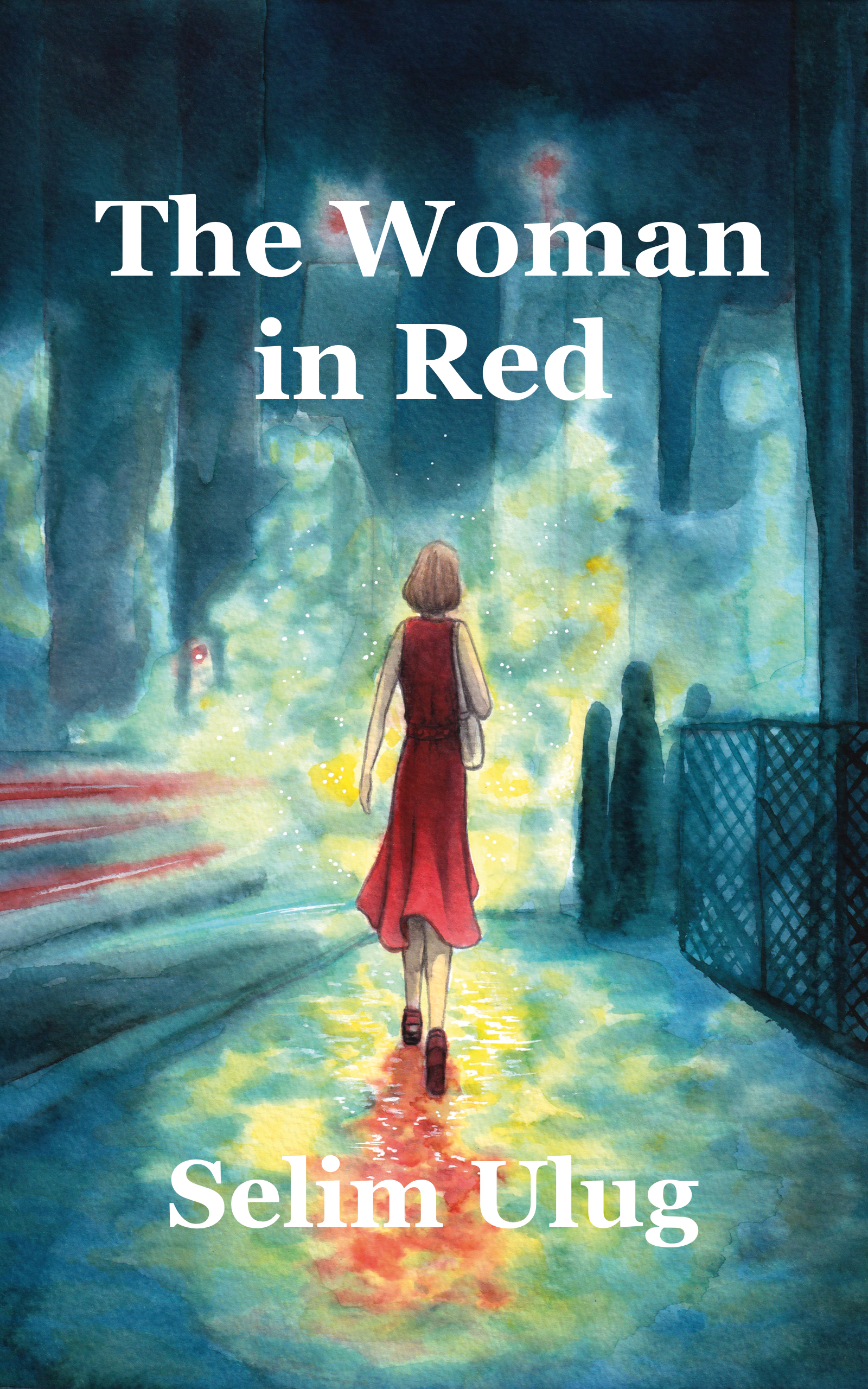
The Woman in Red is available from the Amazon bookstore.
Amazon.co.uk: https://www.amazon.co.uk/Woman-Red-Selim-Ulug/dp/B0BMJGLF5N/ref=tmm_pap_swatch_0?_encoding=UTF8&qid=1669407189&sr=8-1
It can be scary, putting yourself out there. Sharing with the world something you created. Because when you do that, you’re leaving yourself vulnerable. Open to criticism. To ridicule, even. No one likes to be embarrassed.
But if you’re of a creative bent, there’s little choice. Yes, you can create things just for yourself. Horde them like Scrooge McDuck, and open the vault once in a while to play with your darlings. That’s a lot safer. But not very satisfying.
We create is for ourselves, but we also create to communicate with others. That communication goes both ways. We communicate with the world via our art, be it writing, illustration, sculpture, acting, sound design, or what have you. And the world communicates with us in the form of criticism, praise (if you’re lucky), or indifference. To say nothing is to speak volumes.
For those of us who write, many began their journeys in one fandom or another. Yes, I’m talking about fan fiction. It’s an attractive place to start because the characters and setting are already established, leaving you free to focus on story. You might also find yourself cultivating a number of friends in the community who support you while you support them. But to make that first step, to post your first fanfic, that’s a hard thing to do. After all, not everyone online is supportive. In fact, there are plenty out there who seem to thrive on spreading misery. They are to be ignored. For what it’s worth, in my fan fiction experience, I never had haters, just supporters, and I count myself very fortunate .
As you grow as a writer, with practice and with the support of your writing community, you might find yourself branching out to original fiction. Or not. We write, after all, for the love of it. There are, at the time of writing, about 76 thousand Doctor Who fan fics posted on FanFiction.net. Several tens of thousands more are posted on archiveofourown.org. There are sites where you can post original fiction and interact with community members of similar interests. Examples include Wattpad and Inkitt. You can also go the self-publishing route if you’re so inclined. I happen to know at least one pretty good self-published book …
This is truly the golden age of creative output. With the tools we have readily available at home, we can easily create all manner of works and make them available to others. And you never know what will come of it. Anyone remember this tweet from Emily Cook?

After organizing this event, plus a number of others, as well as producing outstanding extra content from Doctor Who alumni, Ms. Cook is now a Big Finish producer. Jonathan Carley, who put himself out there as, among other things, an interpreter of the War Doctor, now has two Big Finish box sets in which he has starred. Jaspreet Singh, who has produced, edited, and sound designed a number of Doctor Who fan productions (including my personal favourite, Doctor Who: The Eighth Day), has been doing editing and sound design work for Big Finish. (He also does a pretty mean Third Doctor.)
Let’s be honest. Commercial success in the arts is hard to come by. So while it’s fine to hope for that, don’t make it the sole driver for your output. Create what you create for the love and fun of it, and if nothing else, you’ll be making the lives of those around you a little bit brighter, which is perhaps the greatest success of all.
Suppose you’re a writer and you want to write for a rich, established universe. Think Doctor Who, Star Trek, or Star Wars, for example. The question becomes, how do you write something that is original but consistent with all of that backstory?
Let’s stick with Doctor Who for now. The show started over 50 years ago, and although there was that hiatus between 1989 and 2005, that’s still a lot of content. But wait, that’s not all! You also get many books, graphic novels and audio dramas (yay Big Finish!). It’s enough to make your head explode. Unless you’re a Time Lord.
So what’s a poor, human, head-about-to-explode writer to do? Well, we can be grateful that there are websites like http://tardis.wikia.com/wiki/Doctor_Who_Wiki. Here you’ll find just about every fact about Doctor Who that exists. If you search for the Third Doctor, for example, you’ll learn about all his adventures in chronological order across all media. As a resource, this site is invaluable. And yet, there’s still a limit to what you can absorb, and there may be details omitted within a given adventure that contradict something in your writing.
I’m afraid this is one of those posts where I have no brilliant solutions. If you actually owned the property, rather than, say, the BBC owning Doctor Who or CBS owning Star Trek, or Disney owning Star Wars, then you could consider crowdsourcing the story. Put the whole thing online, then act on the feedback you get to make the story better. Andy Weir famously did this with his novel, The Martian, with contributors pointing out sciency things that could use some tightening.
If you’re writing fanfiction, then you can do this by posting the story on fanfiction.net, for example. I posted a very short and hopefully humorous Lord of the Rings story there. Once. It was inspired by a review of one of the Hobbit movies that pointed out that the eagles are a kind of deus ex machina in Tolkien’s writing. As multiple readers pointed out, that premise was fully explored in a YouTube video in which our heroes bypass the whole adventure by simply flying with the ring directly to Mount Doom. Rats. That episode cured me of any further desire to write LotR stories. You’ve really got to know your stuff, especially for that fandom.
Posting content online yourself doesn’t really work if you’re writing commercially for someone’s existing intellectual property. As with most things, I suppose you can only do as much research as you can (and as your deadline permits) and do your best.
PS Have I mentioned that Landbound has been released by Big Finish? Oh.
If you’ve been part of a software development and/or engineering team, you’ll understand the concept of unity of purpose. The same principle, it turns out, applies to writing.
They say there are many roads that lead to Rome. If Rome represents the product you want to build, beit a smartphone app, some new whiz-bang hardware, or, let’s say, a story, there’s more than one path you can take to get there. That’s fine if you’re traveling solo. But if you’re part of a team, and different voices are calling out to take this path or that other one or that other other one, it can be a problem. You can end up with a product that looks like the equivalent of a Reaver ship, a cacophony of parts that kinda-sorta work together, but that were never meant to be components of the same whole.
This is why development teams have an architect. This isn’t someone who designs buildings. Well, it can be if what you’re building is, you know, a building. The product architect is someone whose vision of the product carries the day. There can only be one vision, and the team has to buy into this vision. Otherwise, what you end up with is a mess.
The word “mess” has been used more than once to describe a couple of recent superhero movies: Avengers: Age of Ultron, and Batman V Superman: Dawn of Justice. The problem with both of these? Among others, too many characters. Too many future movie plotlines to set up.
Dawn of Justice also suffers from too 
many plots grafted together, too much left out, too many unanswered questions. Why did we need to borrow from both“The Dark Knight Returns” and “Death of Superman” storylines? Each was a major story arc in and of itself and could have carried a movie.
The interesting question is, why do these films suffer from these shortcomings?
 The (likely) answer: Too many fingers in the pie. While these films do have an architect (Joss
Whedon, Zack Snyder) the studios at some level placed too many constraints on the films. Rather
than being allowed to tell a coherent story and tell it well, let’s throw in a few new characters that we want to develop in future movies. Let’s introduce elements that we’re going to explore in future movies. Let’s have more than the last move: bigger, faster, louder.
This was likely one of the reasons the Bond film Quantum of Solace fell short. Forget about telling a compelling story. We need more action that the last film. More chase scenes. And so you end up with a film that has car chases, foot chases, boat chases, and plane chases. Indeed, they seem to have covered all the bases, and the movie is all the poorer as a result. Contrast that with the subsequent Skyfall, perhaps the best Bond ever, where the set pieces and action were driven by the story rather than the other way around.
So what does all this have to do with writing? (Let’s leave screenwriters out for the moment.) After all, most stories are written by only one or maybe two authors. The relevance is that a story has to have a coherent thread driving it forward. Sure, there are supporting characters, several of which can have arcs of their own, but these have to fit together into a coherent whole. You can’t just wander off willy nilly and explore every neat idea. Probably better to keep a “neat idea” file, and to keep your story lean and to the point.
This topic slides into another: How much is too much? By that I mean, I’m not a big fan of filler, even if it’s filler that doesn’t distract from the overall plot. I love a good, thick book as much as the next guy, and I’ve read some series where each book was a door stopper, and yet, I’ve been pretty sure that these stories could have been told with far fewer, thinner books.
It’s a trade off. On the one hand, it can be a real pleasure immerse yourself in the minutia of a new world. On the other hand, you can find yourself wishing the author would just get to the point. Personally, I’m becoming nostalgic for the days when the average novel seemed to be on the order of 200 pages, or even less.
Less, after all, can be more, which applies to both novel length and the number of fingers in the pie.
Horror has changed.
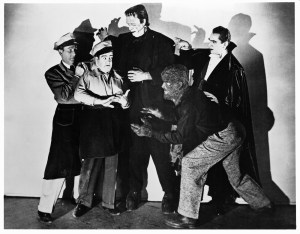
Once upon a time, on a dark and story night, horror was Frankenstein’s monster, the Wolf Man, or Dracula. Or all three.
When I was a kid, Abbott and Costello Meet Frankenstein was on TV one afternoon while my mother was ironing. I was able to stick with it until Lawrence Talbot spied a full moon and, well, you know what came next.
 “MOM!” I screeched. “Change the channel.”
She dutifully did so, switching to a soap opera. After a while I calmed down and begged her to go back to the movie. I was fine then, at least until Talbot’s next transformation.
“MOM! Change the channel!”
I loved it. Loved getting scared right to death. And I still do to this day.
When I was in my early teens, I discovered H.P. Lovecraft, and immediately fell in love. The Dream Quest of Unknown Kadath remains one of my favourite books. How could you not be scared when the Old Gods were after you? Or when rubbery, foul-smelling, ameboid-shaped abominations poked and prodded you as you descended fitfully to the Dream World and left your sanity behind, one step at a time?
As I started to wonder about writing horror fiction, and I read some horror anthologies and sources such as Nightmare magazine, I started to think about what constitutes horror fiction today. It occurred to me that horror has changed. It’s not so much about monsters in the dark any more. There may well be monsters in the dark, but the real horror is what those humans trapped in the house do to each other while the monsters lurk outside.
The classic modern example is TV’s The Walking Dead, a show brilliant in its writing and acting, but so dark and bleak that I stopped watching around the third season. Yes, there are zombies all about, but even as the world falls apart around their ears, people are still hungry for power, for the chance to one-up each other, and as ever, there are romantic triangles.
The idea, I think, is that when horror exists, we discover some truth about ourselves, something we prefer not to think about, a quality better left unspoken. And man, that’s frightening.
 SelimPensFiction