If, like me, you’ve read several books about how to write a novel, you’ll know that there are about as many writing processes as there are writers. In this post, I’ll try to tell you about mine. But take it with a grain of salt. After all, I’ve only written one novel. I may need to update this post after my second.
The first thing you should know about me is that, in my working career, I worked in a number of roles centered around software development. Back in the old days, project teams used a software development process called the waterfall method. First, you figured out what the software was supposed to do. This was documented as a set of requirements. Next you designed the software to do what it was supposed to, and your design would be developed in increasingly detailed layers until, at the most detailed layer, it was ready to be implemented in software. When the software was finished, it was tested. Seems reasonable.
The problem is that, in practice, the waterfall method didn’t work very well. It was all too often the case that the requirements needed to change along the way. When they did, any design and implementation affected by the change would need to be re-worked. Change was expensive and led to conflicts between the developer and the customer. Another problem was that, sometimes, when you got down to the nitty gritty of writing the software, you realized that, well, it wasn’t going to work. The design might have to be revisited. Maybe the requirements as well.
It was much better to take an iterative approach: identify some key requirements, come up with a software design “scaffolding,” and design and implement some of the key features. Each iteration focused on some number of features. You continue, refining requirements or adding new ones, doing some design, doing some implementation. Experience showed that it was much more effective to develop software this way. When requirements changed, and they almost always change, the cost was much less than if the waterfall process had been in play.
All well and good. So what does this have to do with novel writing? I’m sure you seen that some writers are “plotters” and some are “pantsers.” The former plot out the story in exacting detail. The latter write by the seat of their pants without a firm idea of where they are going.
My writing process was somewhere in the middle, and bears some resemblance to the iterative software development process. I started with the fact that this book was going to be a thriller. It had to be fast-paced, but not exhausting. In other words, action, break, action, break, as a kind of overarching structure. An architectural scaffolding, if you like.
I like to distinguish plot–what happens–versus what the story is actually about. The theme, in other words. I knew early on that I wanted one of the themes to be about family. Later on, I realized that mothers and daughters was going to be another theme. Another theme, the evolution of friendship, emerged later still. The point is, that even the themes were developed dynamically. In some cases, I knew what I was shooting for from the start, and other themes emerged through the writing. In those cases, I would retcon earlier chapters to support a new theme.
While I knew roughly where I wanted the story to end up, the road taking me there was quite dynamic. For instance, I was goofing around with my son, trading a pair of cool looking sunglasses. When I put them on, I looked in the mirror and said, “Maximum cool!” And then I dared myself to add a character to the book called Max Cool. After a bit of research, I found that Kool was a legit last name, so Max Cool became Max Kool, a construction foreman who instructs Katy on self defence techniques.
I kept a separate notes file, in which I jotted down questions to myself, possible directions in which to take the story, and even who the main villain would turn out to be, and whether a given character was good or evil. Also, there was a preliminary chapter breakdown, with just a sentence describing where I wanted a given chapter to take the story. This was fluid, but it was a kind of structure to get me started.
The story is set in 2021, and in the world of the story COVID never happened. Who wants to live through that again? One of the notes I made to myself was I was writing was to incorporate news stories from that time. The thought was that this would more firmly place the story in 2021. But virtually every headline that year was related to COVID, so you won’t see current events colouring the text.
At some point, maybe when the book was about half done, I wrote an outline of the last chapter. It helped reinforce in my mind what had to happen before I got there. It was quite a thing to finally reach that chapter and flesh it out. At around the same time I commissioned Georgia Cook—who I was aware of from her Big Finish Doctor Who stories—to provide a cover illustration. Having this in front of me proved quite inspiring. I didn’t post it online right away, but showed to family and friends, who all reacted the same way: it’s gorgeous!
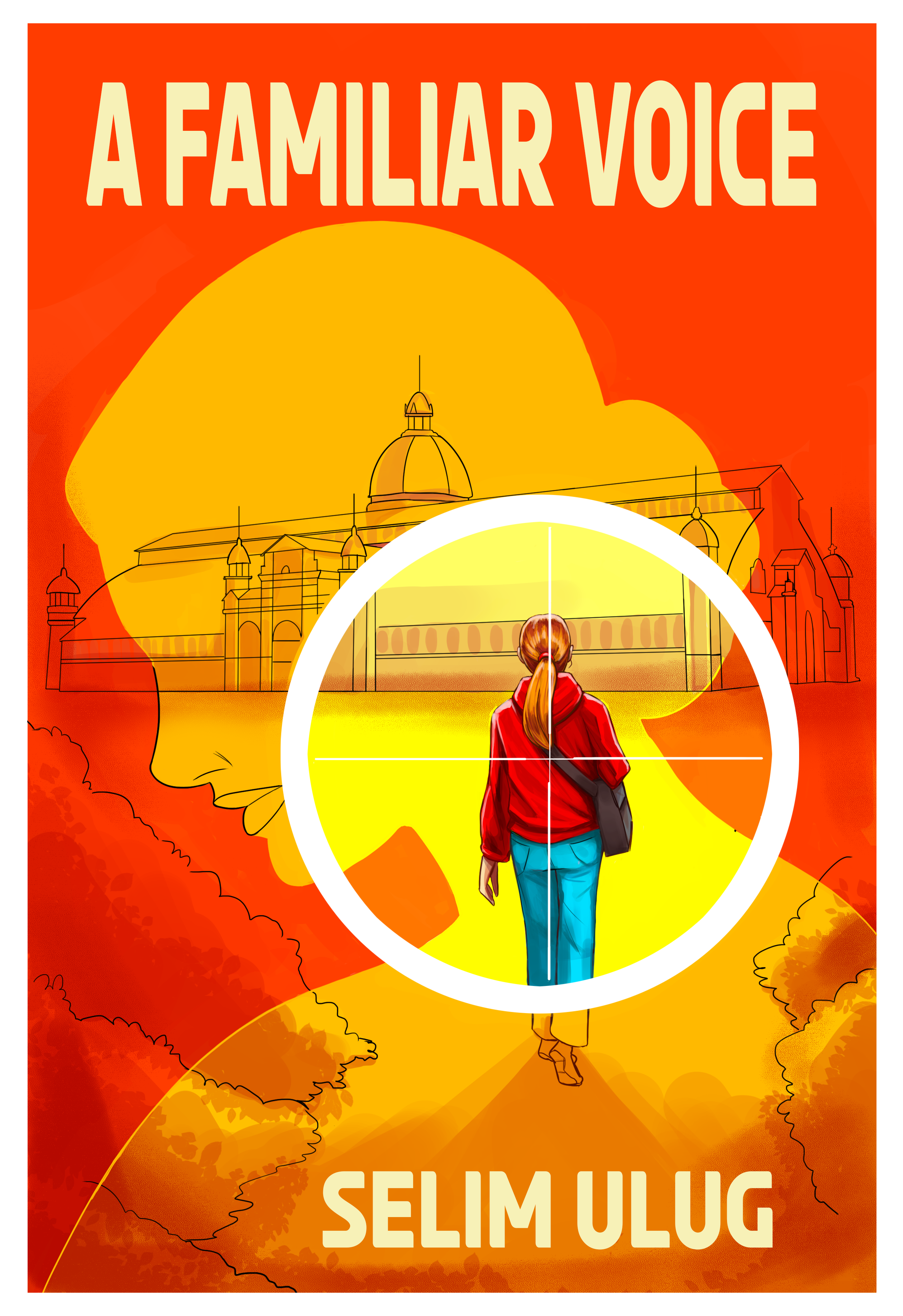
The novel took me about three years to write. Not because I was writing great literature, but because I often wrote little more than a few sentences per day. Some days I didn’t write at all. I frequently read what had come before, so there was lots of chance to catch typos, plotting errors, and so on. It goes to show you, though, that you can finish a book even if you have little time to spend on it. I’m retired, so in theory there should be lots of time, but I never wanted writing to become a second career. It’s a hobby that I greatly enjoy. I found very quickly that if I forced myself to spend a given amount of time on it, that it wasn’t fun anymore. So, slow and steady it went until it was all done.
As I write, it’s all done except for the busy work. I hired an editor for my first short story collection, but realistically, a self-published book doesn’t make a lot of money. Having learned some important lessons from my editor the first time around, I’ve elected to edit my own writing. For better or for worse. And that’s what the last few weeks of the writing process has been: iterations of reviewing, revising, and repeating until I don’t find anything more I want to change. The last stage will be to work through Amazon’s KDP process to get the book up at their store.
If you’re working on a novel, I hope this helps in some small way and I wish you all the luck and success in the world.
 SelimPensFiction